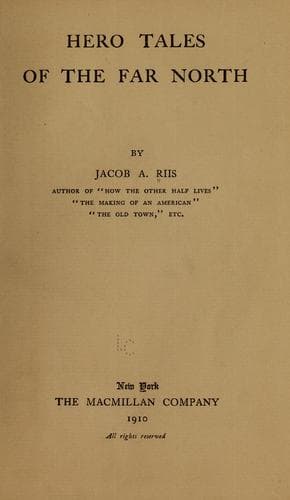
Hero Tales of the Far NorthRiis, Jacob A. (Jacob August)
History
Hero Tales of the Far North
Riis, Jacob A. (Jacob August)
Scandinavia -- History
They sailed homeward over sunny seas, until they came to the shore
where the royal lover awaited his bride, impatiently scanning the
horizon for the gilded dragon’s head of the ship that bore her. The
minstrel sings of the great wedding that was held in the old city
of Ribe.[8] The gray old cathedral in which they knelt together
still stands; but of Valdemar’s strong castle only a grass-grown
hill is left. It was the privilege of a bride in those days to ask
a gift of her husband on the morning after the wedding, and have it
granted without question. Two boons did Dagmar crave,
“right early in the morning, long before it was day”:
one, that the plow-tax might be forgiven the peasant, and that
those who for rising against it had been laid in irons be set free;
the other, that the prison door of Bishop Valdemar be opened.
Bishop Valdemar was the arch-enemy of the King. The first request
he granted; but the other he refused for cause:
An’ he comes out, Bishop Valdemar,
Widow he makes you this year.
And he did his worst; for in the end the King yielded to Dagmar’s
prayers, and much mischief came of it.
Seven years the good queen lived. Seven centuries have not dimmed
the memory of them, or of her. The King was away in a distant part
of the country when they sent to him in haste with the message
that the queen was dying. The ballad tells of his fears as he sees
Dagmar’s page coming, and they proved only too true.
The king his checker-board shut in haste,
The dice they rattled and rung.
Forbid it God, who dwells in heaven,
That Dagmar should die so young.
In the wild ride over field and moor, the King left his men far
behind:
When the king rode out of Skanderborg
Him followed a hundred men.
But when he rode o’er Ribe bridge,
Then rode the king alone.
The tears of weeping women told him as he thundered over the
drawbridge of the castle that he was too late. But Dagmar had only
swooned. As he throws himself upon her bed she opens her eyes, and
smiles upon her husband. Her last prayer, as her first, is for
mercy and peace. Her sin, she says, is not great; she has done
nothing worse than to lace her silken sleeves on a Sunday. Then she
closes her eyes with a tired sigh:
The bells of heaven are chiming for me;
No more may I stay to speak.
Public-domain text, read in full here on John Shaqi.
Reviews
Reviews
No reviews yet
Be the first to share your thoughts on this work.
Elsewhere in the archive
Join the Discussion
Join the discussion
Sign in to leave a comment or review.
Sign InorCreate an account