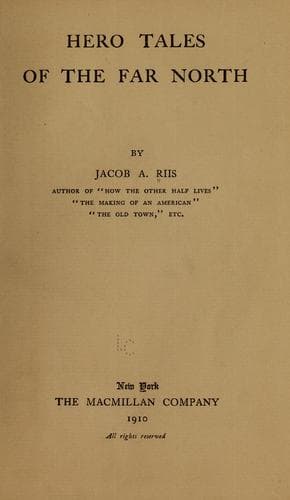
Hero Tales of the Far NorthRiis, Jacob A. (Jacob August)
History
Hero Tales of the Far North
Riis, Jacob A. (Jacob August)
Scandinavia -- History
They were poor, and the change from the genial skies of sunny Italy
to the bleak North did not make it any easier for them. Enrico’s
teacher saw it, and gave him his overcoat to be made over. But
the boys spotted it and squared accounts with their teacher by
snowballing the wearer of the big green plaid until he was glad to
leave it at home, and go without. He was in the military school
when war broke out with Germany in 1848. Both of his brothers
volunteered, and fell in battle. Enrico was ordered out as
lieutenant, and put on the shoulder-straps joyfully, to the great
scandal of his godfather in Milan, who sympathized with the German
cause. When the young soldier refused to resign he not only cut him
off in his will, but took away a pension of four hundred kroner
he had given his mother in her widowhood. If he had thoughts of
bringing them over by such means, he found out his mistake. Mother
and son were made of sterner stuff. Dalgas fought twice for his
country, the last time in 1864, as a captain of engineers.
It was no ordinary class, the one of 1851 that resumed its studies
in the military high school. Two of the students did not answer
roll-call; their names were written among the nation’s heroic dead.
Some had scars and wore the cross for valor in battle. All were
first lieutenants, to be graduated as captains. Dalgas had himself
transferred from the artillery to the engineers, and was detailed
as road inspector. So the opportunity of his life came to him.
There were few railways in those days; the highways were still the
great arteries of traffic. Dalgas built roads that crossed the
heath, and he learned to know it and the strong and independent,
if narrow, people who clung to it with such a tenacious grip. He
had a natural liking for practical geology and for the chemistry
of the soil, and the deep cuts which his roads sometimes made gave
him the best of chances for following his bent. The heath lay as
an open book before him, and he studied it with delight. He found
the traces of the old forests, and noted their extent. Occasionally
the pickaxe uncovered peat deposits of unsuspected depth and
value. Sometimes the line led across the lean fields, and damages
had to be discussed and assessed. He learned the point of view
of the heath farmer, sympathized with his struggles, and gained
his confidence. Best of all, he found a man of his own mind, a
lawyer by the name of Morville, himself a descendant of the exiled
Huguenots. It is not a little curious that when the way was cleared
for the Heath Society’s great work, in its formal organization with
M. Mourier-Petersen, a large landowner, as their associate in its
management, the three men who for a quarter of a century planned
the work and marked out the groove in which it was to run were
all of that strong stock which is by no means the most common in
Denmark.
Public-domain text, read in full here on John Shaqi.
Reviews
Reviews
No reviews yet
Be the first to share your thoughts on this work.
Elsewhere in the archive
Join the Discussion
Join the discussion
Sign in to leave a comment or review.
Sign InorCreate an account