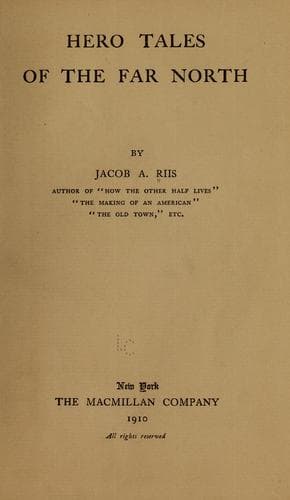
Hero Tales of the Far NorthRiis, Jacob A. (Jacob August)
History
Hero Tales of the Far North
Riis, Jacob A. (Jacob August)
Scandinavia -- History
Gustav Adolf was in his thirty-eighth year when he fell. Of stature
he was tall and stout, a fair-haired, blue-eyed giant, stern in
war, gentle in the friendships of peace. He was a born ruler of
men. Though he was away fighting in foreign lands all the years of
his reign, he kept a firm grasp on the home affairs of his kingdom.
One traces his hand everywhere, ordering, shaping, finding ways, or
making them where there was none. The valuable mines of Sweden were
ill managed. The metal was exported in coarse pigs to Germany for
very little, worked up there, and resold to Sweden at the highest
price. He created a Board of Mines, established smelteries, and the
day came when, instead of going abroad for its munitions of war,
Sweden had for its customers half Europe. Like Christian of Denmark
with whom he disagreed, he encouraged industries and greatly
furthered trade and commerce. He built highways and canals, and he
did not forget the cause of instruction. Upon the university at
Upsala he bestowed his entire personal patrimony of three hundred
and thirteen farms as a free gift. His people honor him with cause
as the real founder of the Swedish system of education.
The master he was always. Sweden had, on one hand, a powerful,
able nobility; on the other, a strong, independent peasantry,—a
combination full of pitfalls for a weak ruler, but with equal
promise of great things under the master hand. His father had cowed
the stubborn nobles with the headsman’s axe. Gustav Adolf drew
them to him and imbued them with his own spirit. He found them a
contentious party within the state; he left them its strongest
props in the conduct of public affairs. Nor was it always with
persuasion he worked. His reward for the unjust judge has been
quoted. When the council failed to send him supplies in Germany,
pleading failure of crops as their excuse, he wrote back: “You
speak of the high prices of corn. Probably they are high because
those who have it want to profit by the need of others.” And he set
a new chief over the finances. On the other hand, he gave shape
to the relations between king and people. The Riksdag held its
sessions, but the laws that ruled it were so vague that it was no
unusual thing for men who were not members at all to attend and
join in the debates. Gustav Adolf put an abrupt end to “a state
of things that exposed Sweden to the contempt of the nations.”
As he ordered it, the initiative remained with the crown; it was
the right of the Riksdag to complain and discuss; of the King to
“choose the best” after hearing all sides.
Public-domain text, read in full here on John Shaqi.
Reviews
Reviews
No reviews yet
Be the first to share your thoughts on this work.
Elsewhere in the archive
Join the Discussion
Join the discussion
Sign in to leave a comment or review.
Sign InorCreate an account