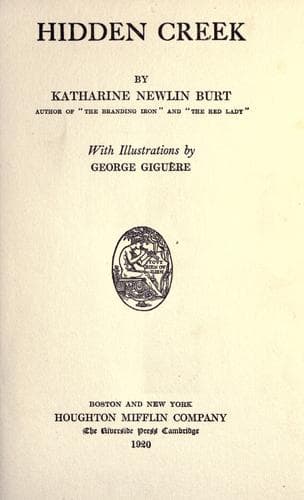
Frontier and pioneer life -- West (U.S.) -- Fiction; Orphans -- Fiction; Young women -- Fiction
There she sat for an hour, listening to the silence. Her mind busied
itself with trivial memories. She thought of Amelia Plecks.... It would
have comforted her to hear that knock and the rattle of her dinner tray.
The little sitting-room at Hudson's Hotel, with its bit of tapestry and
its yellow tea-set and its vases filled with flowers, seemed to her
memory as elaborate and artificial as the boudoir of a French princess.
Farther than Millings had seemed from her old life did this dark little
gabled attic seem from Millings. What was to be the end of this strange
wandering, this withdrawing of herself farther and farther into the
lonely places! She longed for the noise of Babe's hearty, irrepressible
voice with its smack of chewing, of her step coming up the stairs to that
little bedroom under Hudson's gaudy roof. Could it be possible that she
was homesick for Millings? For the bar with its lights and its visitors
and its big-aproned guardian? Her lids were actually smarting with tears
at the recollection of Carthy's big Irish face.... He had been such a
good, faithful watch-dog. Were men always like that--either watch-dogs
or wolves? The simile brought her back to Hidden Creek. It grew darker
and darker, a heavy darkness; the night had a new soft weight. There
began to be a sort of whisper in the stillness--not the motion of pines,
for there was no wind. Perhaps it was more a sensation than a sound, of
innumerable soft numb fingers working against the silence ... Sheila got
up, shivering, lighted her candle, and went over to the small, four-paned
window under the eaves. She pressed her face against it and started back.
Things were flying toward her. She opened the sash and a whirling scarf
of stars flung itself into the room. It was snowing. The night was blind
with snow.
CHAPTER IX
WORK AND A SONG
On the studio skylight the misty autumn rain fell that night, as the snow
fell against Sheila's window-panes, with a light tapping. Below it Dickie
worked. He had very little leisure now for stars or dreams. For the first
time in his neglected and mismanaged life he knew the pleasure of
congenial work; and this, although Lorrimer worked him like a slave. He
dragged him over the city and set his picture-painting faculty to labor
in dark corners. Dickie, every sense keen and clean, was not allowed to
flinch. No, his freshness was his value. And the power that was in him,
driven with whip and spur, throve and grew and fairly took the bit in its
teeth and ran away with its trainer.
Public-domain text, read in full here on John Shaqi.
Reviews
Reviews
No reviews yet
Be the first to share your thoughts on this work.
Elsewhere in the archive
Join the Discussion
Join the discussion
Sign in to leave a comment or review.
Sign InorCreate an account