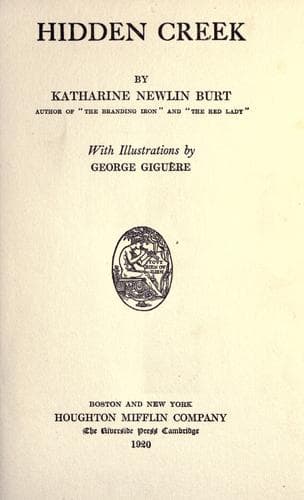
Frontier and pioneer life -- West (U.S.) -- Fiction; Orphans -- Fiction; Young women -- Fiction
The fresh snow sunk a little under her webs, but she was a featherweight
of girlhood, and made quicker and easier progress than would have been
possible to any one else but a child. And her fear gave her both strength
and speed. Sometimes she looked back over her shoulder; always she
strained her ears for the pad of following feet. It was a day of rainbows
and of diamond spray, where the sun struck the shaken snow sifted from
overweighted branches. Sheila remembered well enough the route to the
post-office. It meant miles of weary plodding, but she thought that she
could do it before night. If not, she would travel by starlight and the
wan reflection of the snow. There was no darkness in these clear, keen
nights. She would not tell herself what gave her strength such impetus.
She thought resolutely of the post-office, of the old, friendly man, of
his stove, of his chairs and his picture of the President, of his gun
laid across two nails against his kitchen wall--all this, not more than
eighteen miles away! And she thought of Hilliard, too; of his young
strength and the bold young glitter of his eyes.
She stopped for a minute at noon to drink some water from Hidden Creek
and to eat a bite or so of bread. She was pulling on her gloves again
when a distant baying first reached her ears. She turned faint, seemed to
stand in a mist; then, with her teeth set defiantly, she started again,
faster and steadier, her body bent forward, her head turned back. Before
her now lay a great stretch of undulating, unbroken white. At its farther
edge the line of blue-black pines began again. She strained her steps to
reach this shelter. The baying had been very faint and far away--it might
have been sounded for some other hunting. She would make the woods, take
off her webs, climb up into a tree and, perhaps, attracted by those four
shots--no, three, she must save one--some trapper, some unimaginable
wanderer in the winter forest, would come to her and rescue her before
the end. So her mind twisted itself with hope. But, an hour later, with
the pines not very far away, the baying rose so close behind that it
stopped her heart. Twenty minutes had passed when above a rise of ground
she saw the shaggy, trotting black-gray body of Brenda, the leader of the
pack. She was running slowly, her nose close to the snow, casting a
little right and left over the tracks. Sheila counted eight--Berg, then,
had joined them. She thought that she could distinguish him in the rear.
It was now late afternoon, and the sun slanted driving back the shadows
of the nearing trees, of Sheila, of the dogs. It all seemed
fantastic--the weird beauty of the scene, the weird horror of it. Sheila
reckoned the distance before her, reckoned the speed of the dogs. She
knew now that there was no hope. Ahead of her rose a sharp, sudden
slope--she could never make it. There came to her quite suddenly, like a
gift, a complete release from fear. She stopped and wheeled. It seemed
Public-domain text, read in full here on John Shaqi.
Reviews
Reviews
No reviews yet
Be the first to share your thoughts on this work.
Elsewhere in the archive
Join the Discussion
Join the discussion
Sign in to leave a comment or review.
Sign InorCreate an account