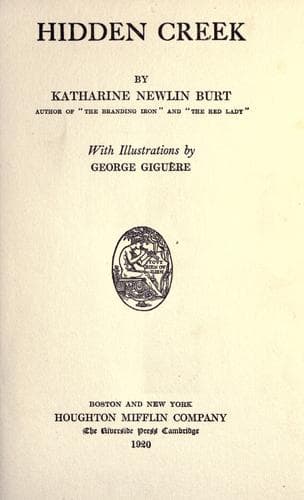
Frontier and pioneer life -- West (U.S.) -- Fiction; Orphans -- Fiction; Young women -- Fiction
This time, exhausted as he was, Dickie did not fail to stand up to take
the cup she brought him. He shook his head at the dry clothes. He didn't
want Hilliard's things, thank you; he was drying out nicely by the fire.
He wasn't a bit cold. He sat and drank the tea, leaning forward, his
elbows on his knees. He was, after all, just the same, she decided--only
more so. His Dickie-ness had increased a hundredfold. There was still
that quaint look of having come in from the fairy doings of a midsummer
night. Only, now that his color had come back and the light of her lamp
shone on him, he had a firmer and more vital look. His sickly pallor had
gone, and the blue marks under his eyes--the eyes were fuller, deeper,
more brilliant. He was steadier, firmer. He had definitely shed the
pitifulness of his childhood. And Sheila did not remember that his mouth
had so sweet a firm line from sensitive end to end of the lips.
Her impatience was driving her heart faster at every beat.
"You _must_, please, tell me everything now, Dickie," she pleaded,
sitting on the arm of Hilliard's second chair. Her cheeks burned; her
hair, grown to an awkward length, had come loose from a ribbon and fallen
about her face and shoulders. She had made herself a frock of
orange-colored cotton stuff--something that Hilliard had bought for
curtains. It was a startling color enough, but it could not dim her gypsy
beauty of wild dark hair and browned skin with which the misty and
spiritual eyes and the slightly straightened and saddened lips made
exquisite disharmony.
Dickie looked up at her a minute. He put down his cup and got to his
feet. He went to stand by the shelf, half-turned from her.
"Tell me, at least," she begged in a cracked key of suspense, "do you
know anything about--_Hilliard_?"
At that Dickie was vividly a victim of remorse.
"Oh--Sheila--damn! I _am_ a beast. Of course--he's all right. Only, you
see, he's been hurt and is in the hospital. That's why I came."
"You?--Hilliard?--Dickie. I can't really understand." She pushed back her
hair with the same gesture she had used in the studio when Sylvester
Hudson's offer of "a job" had set her brain whirling.
"No, of course. You wouldn't." Dickie spoke slowly again, looking at the
rug. "I went East--"
"But--Hilliard?"
He looked up at her and flashed a queer, pained sort of smile. "I am
coming to him, Sheila. I've got to tell you _some_ about myself before I
get around to him or else you wouldn't savvy--"
"Oh." She couldn't meet the look that went with the queer smile, for it
was even queerer and more pained, and was, somehow, too old a look for
Dickie. So she said, "Oh," again, childishly, and waited, staring at
her fingers.
"I went to New York because I thought I'd find you there, Sheila. Pap's
hotel was on fire."
"Did you really burn it down, Dickie?"
He started violently. "_I_ burned it down? Good Lord! No. What made you
think such a thing?"
"Never mind. Your father thought so."
Public-domain text, read in full here on John Shaqi.
Reviews
Reviews
No reviews yet
Be the first to share your thoughts on this work.
Elsewhere in the archive
Join the Discussion
Join the discussion
Sign in to leave a comment or review.
Sign InorCreate an account