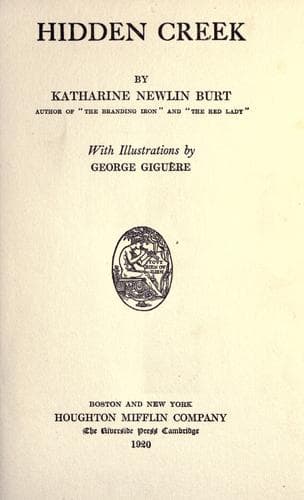
Frontier and pioneer life -- West (U.S.) -- Fiction; Orphans -- Fiction; Young women -- Fiction
But as the night went slowly by, he faced this desolation with
extraordinary fortitude. It was part of that curious detachment, that
strange gift of impersonal observation. Dickie bore no grudges against
life. His spirit had a fashion of standing away, tiptoe, on wings. It
stood so now like a presence above the miserable, half-starved body that
occupied the bench and suffered the sultriness of August and the pains of
abstinence. Dickie's wide eyes, that watched the city and found it
horrible and beautiful and frightening, were entirely empty of bitterness
and of self-pity. They had a sort of wistful patience.
There came at last a cool little wind and under its ministration Dickie
let fall his head on his arms and slept. He was blessed by a dream:
shallow water clapping over a cobbled bed, the sharp rustle of wind-edged
aspen leaves, and two stars, tender and misty, that bent close and
smiled. He woke up and stared at the city. He got up and walked about. He
was faint now and felt chilled, although the asphalt was still soft
underfoot and smelled of hot tar. As he moved listlessly along the
pavement, a girl brushed against him, looked up, and murmured to him. She
was small and slight. His heart seemed to leap away from the contact and
then to leap almost irresistibly to meet it. He turned away and went back
quickly toward the Square. It seemed to him that he was followed. He
looked over his shoulder furtively. But the girl had disappeared and
there was no one in sight but a man who walked unsteadily. Dickie
suddenly knew why he had saved that dime. The energy of a definite
purpose came to him. He remembered a swinging door back there around a
corner, but when he reached the saloon, it was closed. Dickie had a
humiliating struggle with tears. He went back to his bench and sat there,
trembling and swearing softly to himself. He had not the strength to look
farther. He was no longer the Dickie of Millings, a creature possessed of
loneliness and vacancy and wandering fancies, he was no longer Sheila's
lover, he was a prey to strong desires. In truth, thought Dickie, seeking
even now with his deprecatory smile for likenesses and words, the city
was full of beasts, silent and stealthy and fanged. That spirit, aloof,
maintained its sweet detachment. Beneath its observation Dickie fought
with a grim, unreasoning panic that was very like the fear of a man
pursued by wolves.
CHAPTER V
NEIGHBOR NEIGHBOR
Public-domain text, read in full here on John Shaqi.
Reviews
Reviews
No reviews yet
Be the first to share your thoughts on this work.
Elsewhere in the archive
Join the Discussion
Join the discussion
Sign in to leave a comment or review.
Sign InorCreate an account