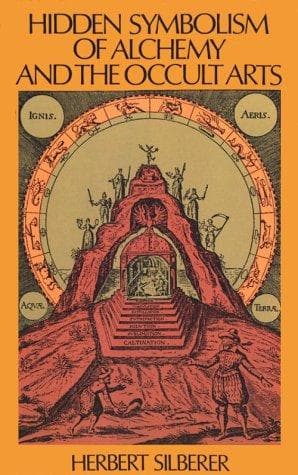
Hidden Symbolism of Alchemy and the Occult ArtsSilberer, Herbert
Religion
Hidden Symbolism of Alchemy and the Occult Arts
Silberer, Herbert
Alchemy; Society of Rosicrucians; Symbolism (Psychology)
That rosicrucianism in its better aspect is identical with the higher
alchemy, can no longer be doubted by any one after the material here
offered. The common psychological element is shown when, as will be done
in later parts of this book, we go into the deeper common basis of alchemy
and freemasonry. Then first will the sought-for “etiological assumption”
attain to its desired clearness. But already this much may be clear: that
we have in both domains, structures with a religious content, even though
from time to time names are used which will veil these facts. I add now in
anticipation a statement whose clear summing up has been reserved for
psychoanalysis, namely that the object of religious worship is regularly
to be regarded as a symbol of the libido, that psychologic goddess who
rules the desires of mankind—and whose prime minister is Eros. [Libido is
desire or the tendency toward desire, as it controls our impulsive life.
In medical language used mainly for sexual desire, the concept of libido
is extended in psychoanalysis (namely by C. G. Jung) to the impelling
power of psychic phenomena in general. Libido would therefore be the inner
view of what must in objective description be called “psychic energy.” How
it could be given this extension of meaning is seen when we know the
possibilities of its transformation and sublimation, a matter which will
be treated later.] Now if the libido symbol raised up for an ideal is
placed too nakedly before the seeker, the danger of misunderstanding and
perversion is always present. For he is misled by his instincts to take
the symbol verbally, that is, in its original, baser sense and to act
accordingly. So all religions are degenerate in which one chooses as a
libido symbol the unconcealed sexual act, and therefore also a religion
must degenerate, in which gold, this object of inordinate desire, is used
as a symbol.
Public-domain text, read in full here on John Shaqi.
Reviews
Reviews
No reviews yet
Be the first to share your thoughts on this work.
Elsewhere in the archive
Join the Discussion
Join the discussion
Sign in to leave a comment or review.
Sign InorCreate an account