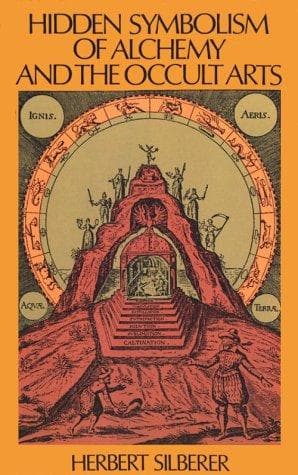
Hidden Symbolism of Alchemy and the Occult ArtsSilberer, Herbert
Religion
Hidden Symbolism of Alchemy and the Occult Arts
Silberer, Herbert
Alchemy; Society of Rosicrucians; Symbolism (Psychology)
What died symbolically or had to die was
represented by an old man who sacrificed himself after suffering all kinds
of fortune. The dying of this old man signified, as analysis showed, the
same thing that we call the “putting off the old Adam” (turning over a new
leaf). The figure of the old man, originally Lea’s grandfather, then her
father, came to have this meaning only after a long process of
intro-determination.
A few more examples for typical figures.
In many dreams of a woman analyzed by me (Pauline, in my treatise Zur
Symbolbildung), a cow appears as a typical image. The alternation of this
cow with more or less definite mother symbols leads to identification of
the cow with the mother. Two circumstantial dreams that were fully
analyzed showed, however, that the cow and other forms with which she
alternated cannot be translated so correctly by the concept of mother as
by that of the maternal authority and finally still more correctly by
self-criticism or conscience, of which maternal authority is but a type.
Children figure in Pauline’s case as a result of various experiences, as
typical of obstacles.
In the case of another dreamer the father stands in similar relation as
the determinant that paralyzes his resolutions.
The climbing of an ascent, usually a symbol of coitus (hurrying upward
which makes us out of breath), turns out often in a deeper relation as the
effort to get from the disagreeable things of life to a place of retreat
(lonely attics, etc.), inaccessible to other persons (= thoughts); and now
we see that this deeper meaning appears without prejudice to the first,
for even coitus, like all transport, is only a special case of flight from
the outer life, one of the forms of spiritual oblivion. Hence in part the
mythologically and psychopathologically important comparison of
intoxication, intoxicating drink and sperm, soma and semen. Ascent =
coitus is in this case a type for a quite comprehensive class of
experience.
Marcinowski found in his analyses that the father in dream life often was
a “symbol of an outlived, obsolete attitude.” (Z. Bl. f. Ps., II, 9.)
Other examples of types are the phallus, the sun and other religiously
revered objects, if we regard them as does Jung (Wandl. u. Sym., Jb. ps.
F., III-IV) as a symbol of the libido. [The concept of which is extended
by Jung almost to Schopenhauer’s Will.] The typical character of divine
personalities is moreover quite clearly emphasized by Jung himself.
Public-domain text, read in full here on John Shaqi.
Reviews
Reviews
No reviews yet
Be the first to share your thoughts on this work.
Elsewhere in the archive
Join the Discussion
Join the discussion
Sign in to leave a comment or review.
Sign InorCreate an account