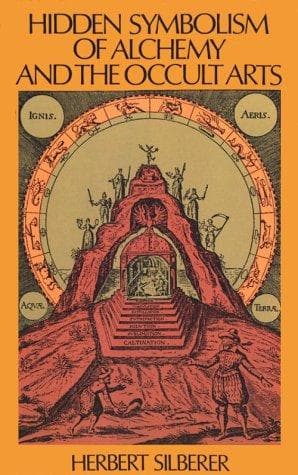
Hidden Symbolism of Alchemy and the Occult ArtsSilberer, Herbert
Religion
Hidden Symbolism of Alchemy and the Occult Arts
Silberer, Herbert
Alchemy; Society of Rosicrucians; Symbolism (Psychology)
Among psychopathologists Jung especially has of late strongly insisted
upon the dangerous rôle of indolence. According to him the libido
possesses a monstrous laziness which is unwilling to let go of any object
of the past, but would prefer to retain it forever. Laziness is actually a
passion, as La Rochefoucauld brilliantly remarks: “Of all the passions the
least understood by us is laziness; it is the most indefatigable and the
most malign of them all, although its outrages are imperceptible.” “It is
the perilous passion affecting the primitive man more than all others,
which appears behind the suspicious mask of the incest symbols, from which
the fear of incest has driven us away, and which above all is to be
vanquished under the guise of the ‘dreaded mother.’ [Vide, Note D. To
avoid a wrong conception of this quotation it must be noted that laziness
is, of course, not to be regarded as the only foundation of incest
symbolism.] She is the mother of infinite evils, not the least of them
being the neurotic maladies. For especially from the vapor of remaining
libido residues, those damaging evils of phantasy develop, which so
enshroud reality that adaptation becomes well nigh impossible.” (Jung,
Psychology of the Unconscious.)
That the indolent shrinking back from the difficulties of life is
indicated so frequently in psychology and in mythology by the symbol of
the mother is not surprising, but I should yet like to offer for a
forceful illustration an episode from the war of Cyrus against Astyages
which I find recorded in Dulaure-Krauss-Reiskel (Zeugg., p. 85.) After
Astyages had aroused his troops, he hurled himself with fiery zeal at the
army of the Persians, which was taken unawares and retreated. Their
mothers and their wives came to them and begged them to attack again. On
seeing them irresolute the women unclothed themselves before them, pointed
to their bosoms and asked them whether they would flee to the bosoms of
their mothers or their wives. This reproachful sight decided them to turn
about and they remained victorious.
On the origin of the mythological and psychological symbol of the dreaded
mother: “Still there appears to reside in man a deep resentment, because a
brutal law once separated him from an impulsive indulgence and from the
great beauty of the animal nature so harmonious with itself. This
separation is clearly shown in the prohibition of incest and its
corollaries (marriage laws). Hence pain and indignation are directed
toward the mother as if she were to blame for the domestication of the
sons of men. In order not to be conscious of his desire for incest (his
regressive impulse toward animal nature) the son lays the entire blame on
the mother, whence results the image of the ‘dreaded mother.’ ‘Mother’
becomes a specter of anxiety to him, a nightmare.” (Jung, Psychology of
the Unconscious.)
Public-domain text, read in full here on John Shaqi.
Reviews
Reviews
No reviews yet
Be the first to share your thoughts on this work.
Elsewhere in the archive
Join the Discussion
Join the discussion
Sign in to leave a comment or review.
Sign InorCreate an account