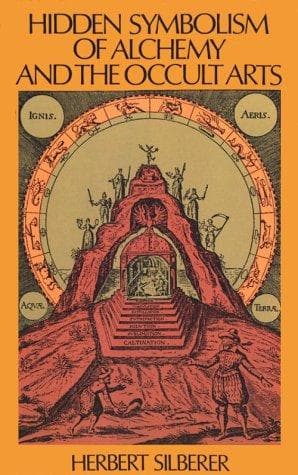
Hidden Symbolism of Alchemy and the Occult ArtsSilberer, Herbert
Religion
Hidden Symbolism of Alchemy and the Occult Arts
Silberer, Herbert
Alchemy; Society of Rosicrucians; Symbolism (Psychology)
Mythologically expressed, introversion proceeds well if the hero defeats
the dragon. If this does not happen, an unsuccessful issue is the result;
the man loses himself. In my opinion this losing of self is possible in
two ways, one active, the other passive. In all there would then be three
terminations of introversion. The good conclusion is the entrance into the
true mystical work, briefly, mysticism. The bad conclusions are the active
way of magic and the passive one of schizophrenia (introversion
psychosis). In the first case there is consummated an inner reunion, in
the other two cases a losing of self; in magic one loses oneself in
passions, for which one wishes to create satisfaction magically, absolving
oneself from the laws of nature; in the case of mental malady the sinking
develops into laziness, a spiritual death. The three paths followed by the
introverting individual correspond roughly to these three other
possibilities of life, work (morality), crime, suicide. These three
possibilities are, of course, recognized by the hermetic art; it
recognizes three fundamental powers, which can give no other result
psychically. Two of these principles are mutually opposed (in the
unpurified condition of the material). We know them quite well as [Symbol:
Fire] and [Symbol: Water], etc. The third principle lies evenly between
the other two, like the staff of Hermes between the two serpents. So the
symbol [Symbol: Mercurius], as Hermes’ staff with the serpents, precisely
unites all three. In this aspect the three qualities or constituents of
matter (prakrti) may at once be substituted for the three fundamental
powers of alchemy according to the Hindu samkhya doctrine. Sattva, Rajas,
Tamas, are translated (by Schroeder) by “purity, passion, darkness.”
In the Bhagavad-Gita it is said of the happiness that these three grant:
“Where one rests after earnest work and arrives at the end of
toil,
Fortune, which appears poison at first, finally is like nectar.
Such a fate is truly good, procured through cheerfulness of
spirit. [Sattva.]
Fortune that first shows like nectar, and finally appears as
poison,
Chaining the senses to the world, belongs to the realm of passion.
[Rajas.]
Fortune that immediately and thereafter strikes the soul with
delusion,
In sleep, indolence, laziness, such Fortune belongs to darkness.”
[Tamas.]
Public-domain text, read in full here on John Shaqi.
Reviews
Reviews
No reviews yet
Be the first to share your thoughts on this work.
Elsewhere in the archive
Join the Discussion
Join the discussion
Sign in to leave a comment or review.
Sign InorCreate an account