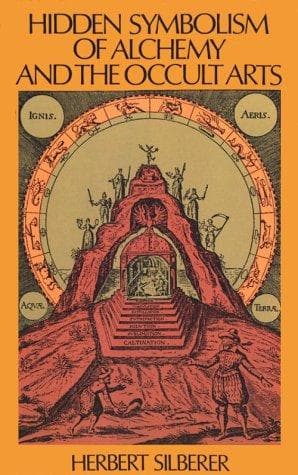
Hidden Symbolism of Alchemy and the Occult ArtsSilberer, Herbert
Religion
Hidden Symbolism of Alchemy and the Occult Arts
Silberer, Herbert
Alchemy; Society of Rosicrucians; Symbolism (Psychology)
In the hermetic book, “Gloria Mundi,” it is related of Adam that he would
have been able, if he had not acted contrary to God, to live 2000 years in
paradise and would then have been taken up into heaven; but he had drawn
on himself death, sickness and calamity. Only through the grace of God was
he given a partial knowledge of the powers of things, of herbs and
remedies against manifold infirmities. “When, however, he could no longer
maintain himself by the medicinal art [in paradise] he sent his son Seth
forth to paradise for the tree of life, which he received, not physically,
but spiritually. Finally he desired the oil of compassion, whereupon by
the angels, at God’s command to give the oil, the promise was given and
thereupon the seed of the oil tree sent, which seed Seth planted on his
return, after his father’s death and on his father’s grave, from which
grew the wood of the holy cross, on which our Lord Jesus Christ, through
his passion and death, freed us from death and all sins; which Lord Christ
in his holiest humanity has become the tree and the wood of life and has
brought to us the fruit of the oil of compassion....” Adam is the
undomesticated man; this ideal must die to the moral aspirant.
The painful duty of killing a part of self is beautifully expressed in the
Bhagavad-Gita, where the hero, Aryuna, hesitates to fight against his
“kindred,” to shoot at them—the bow falls from his hand.
Dying relates to the old realms. The old laws expire to make room for the
new. The new life cancels the old deeds. (Cf. Paul, Rom. VII-VII.)
Vedanta doctrine: But as to the duty of the scripture canon and
perception, both last as long as Samsāra, i.e., until the awakening. If
this is attained, perception is annulled, and if you derive thence the
objection that thereby the veda is annulled, it must be noted that
according to our own doctrine father is not father and the Veda is not the
veda. (Deussen, Syst. d. Ved., p. 449.)
Bhagavad-Gita, IV, 37:
“Like fire when it flames and turns all the firewood to ashes.”
So the fire of knowledge burns for you all deeds to ashes.
For several reasons the father image is peculiarly suited to represent
what has to be resolved. By the father, the old Adam (totality of
inherited instincts) and the strongest imperatives are implanted in the
child. The father is also the type of tenacious adherence to the
ancestors. Again we meet the antithesis, old generation, new generation,
in ourselves after the intro-determination.
The mystical death (sacrifice) is not to be accomplished by mere
asceticism, as it were, mechanically; the alchemists warn us carefully
against severe remedies. The work is to take a natural course; the work is
also, although indeed a consummation of nature, yet not above nature.
“Nature rejoices in nature
Nature overcomes nature
Nature rules nature.”
Thus the magician Osthanes is said to have taught. And the Bhagavad-Gita
(VI, 5-7) says:
Public-domain text, read in full here on John Shaqi.
Reviews
Reviews
No reviews yet
Be the first to share your thoughts on this work.
Elsewhere in the archive
Join the Discussion
Join the discussion
Sign in to leave a comment or review.
Sign InorCreate an account