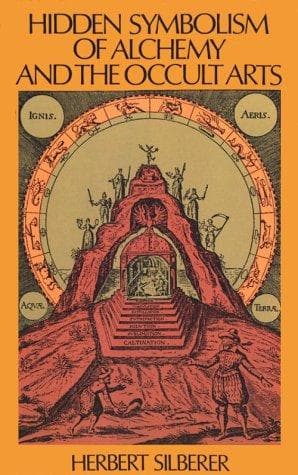
Hidden Symbolism of Alchemy and the Occult ArtsSilberer, Herbert
Religion
Hidden Symbolism of Alchemy and the Occult Arts
Silberer, Herbert
Alchemy; Society of Rosicrucians; Symbolism (Psychology)
Psychoanalysis, like comparative mythology, makes it probable that the
killing or dismemberment of the father figure is equivalent to castration.
That has, according to intro-determination, an anagogic, a wider sense, if
we compare the organ of generation to the creative power, and a narrower,
if we compare it to sexuality. The wider conception does not require
immediate interpretation. With regard to the narrower, I observe that the
mystical manuals show that the most active power for spiritual education
is the sexual libido, which for that reason is partially or entirely
withdrawn from its original use. (Rules of chastity.) “Vigor is obtained
on the confirmation of continence.” (Patanjali, Yoga-Sutra, II, 38.) These
instruction books have recognized the great transmutability of the sexual
libido. (Cf. ability of sublimation in the alchemistic, as well as in the
Freudian terminology.) Naturally the reduction of sexuality had to occur
at the beginning of the work in order to furnish that power; hence the
castration at the commencement of the process. The killing of the phallic
snake amounts, of course, to the same thing. The snake with its tail in
its mouth is the cycle of the libido, the always rolling wheel of life, of
procreation, which always procreates itself, and of the creation of the
world. The same cycle is represented by a god who holds his phallus in his
mouth, and so (in accordance with infantile and primitive theory)
constantly impregnates himself. The serpent is good and also evil. Whoever
breaks through the ring frees himself from the wheel of compulsion, raises
himself above good and evil, in order to put in its place later a mystical
union [Hieros Gamos].
Regarded from the point of view of knowledge, the formation of types
reveals itself as a symbolic presentiment of an anagogic idea, not at
first clearly conceivable. For the spirit, what cannot yet be clearly seen
(mythological level of knowledge) or can no longer be seen (going to
sleep, etc.) is pictured in symbolic form. [More details will be found in
my essays, “Phantasie und Mythos,” “Ueber die Symbolbildung,” and “Zur
Symbolbildung” (Jb. ps. F., II, III, IV).] This symbol form is the form of
knowledge adapted to the spirit’s capacity as it then existed. Not that
any mysterious presentiment or prophetic gift of vision must be assumed.
The circumstance that man can get ever deeper meaning from his symbols
gives them the appearance of being celestial harbingers sent forth by the
latest ideas that they express. In a certain sense, however, the last
meaning is implicated in the first appearance of the typical symbol. It
has already been explained by intro-determination how that was possible.
The psyche, whose inventory of powers is copied symbolically in the
elementary types, knows, even if only darkly at first, the possible
unfolding of the powers. These unfoldings are originally not actual but
potential. [See Note F.]
Public-domain text, read in full here on John Shaqi.
Reviews
Reviews
No reviews yet
Be the first to share your thoughts on this work.
Elsewhere in the archive
Join the Discussion
Join the discussion
Sign in to leave a comment or review.
Sign InorCreate an account