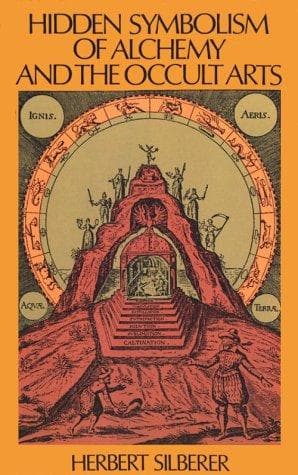
Hidden Symbolism of Alchemy and the Occult ArtsSilberer, Herbert
Religion
Hidden Symbolism of Alchemy and the Occult Arts
Silberer, Herbert
Alchemy; Society of Rosicrucians; Symbolism (Psychology)
The alchemistic process is, as the hermetics themselves say, a cyclical
work, and the end resides to a certain degree in the beginning. Here lies
one of the greatest mysteries of the whole of alchemy, although the
meaning of the language is to be understood more or less as follows. If,
for example, it is said that whoever wishes to make gold must have gold,
we must suppose that the seeker of truth must _be_ true (H. A., p. 67);
that whoever desires to live in harmony with the conscience must be in
harmony with it, and that whoever will go the way to God, must already
have God in himself. Now when the conscience, wherein the sense of right
and justice has existence, becomes active under the idea of God, it is
endowed with supernatural force and is then, as I understand it, the
alchemists’ philosophical mercury and his valued salt of mercury. It is no
less his sovereign treacle, etc. (H. A., p. 53). The progress of the work
points to some kind of unity as the goal which, however, very few men
attain except in words (H. A., p. 157). The hermetic writers set up the
claim to a complete agreement in their teachings, but this agreement is
restricted to some principles of vital significance in their doctrine,
which have reference almost exclusively to a definite practice; probably
to a complete setting to work of the consciousness of duty, which is what
Kant claims to do with his categorical imperative: “An unreasoning, though
not unreasonable, obedience to an experienced, imperious sense of duty,
leaving the result to God; and this I am disposed to call the Way.”
Do thy duty!
Ask not after the result of thy doing!
Without dependence thereon carry out that which is thy duty!
Whoever acts without attachment to the world, that man attains the
loftiest goal.
And the like in many places in the Bhagavad-Gita.
Now the end is perhaps the fruit of this obedience. It may be that the
steady preservation of the inward unity, which regards with composure all
external vicissitudes, leads man finally to some special experience, by
which a seal of confirmation is set upon what was first a mere trust in
the ultimate blessing of rectitude (H. A., p. 128). The hermetic
philosophers would have the conscience known as the Way or as the base of
the work, but with regard to the peculiar wonder work of alchemy
(transmutation) they place the chief value on love; it effects the
transformation of the _subject_ into the _object_ loved (H. A., p. 132).
Arabi: “It is a fundamental principle of love that thou becomest the real
essence of the beloved (God) in that thou givest up thy individuality and
disappearest in him. Blessedness is the abiding place of the divine and
holy joy.” (Horten, Myst., I, p. 9.)
Public-domain text, read in full here on John Shaqi.
Reviews
Reviews
No reviews yet
Be the first to share your thoughts on this work.
Elsewhere in the archive
Join the Discussion
Join the discussion
Sign in to leave a comment or review.
Sign InorCreate an account