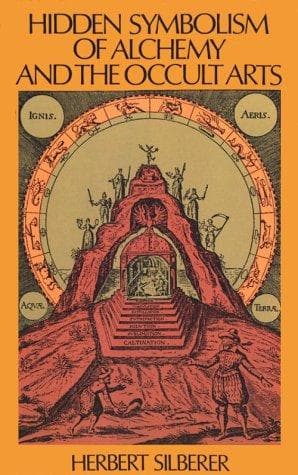
Hidden Symbolism of Alchemy and the Occult ArtsSilberer, Herbert
Religion
Hidden Symbolism of Alchemy and the Occult Arts
Silberer, Herbert
Alchemy; Society of Rosicrucians; Symbolism (Psychology)
the alchemists speak of philosophical mercury and philosophical gold, they
mean something in man and something in God that finally turns out to be
the One. “By this symbolism the alchemists escape the difficulty of
treating the subject in ordinary language. The learner must always return
to nature and her possibilities for the sense of the derived symbols, and
to it the hermetic masters also continually direct him.” (H. A., pp. 232
ff.) If the true light has risen in the hearts of the seekers, kindled
from within (although apparently by a miracle from without) “the sulphur
and mercury become one, or are seen to be the same, differing only in a
certain relation; somewhat as the known and the unknown (and the conscious
and the unconscious) are but one, the unknown decreasing as the known
increases, and vice versa.” (H. A., p. 235.)
One alchemist teaches: “Consider well what it is you desire to produce,
and according to that regulate your intention. Take the last thing in your
intention as the first thing in your principles.... Attempt nothing out of
its own nature [then follow parables that grapes are not gathered from
thistles, etc.]. If you know how to apply this doctrine in your operation
as you ought, you will find great benefit, and a door will hereby be
opened to the discovery of greater mysteries.” Actually there is a greater
difference between one who seeks what he seeks as an end, and one who
seeks it as a means to an end. To seek knowledge for riches is a very
different thing from seeking riches (or independence) as an instrument of
knowledge. In the study in question the means and the end must coincide,
i.e., the truth must be sought for itself only. (H. A., p. 238.) In the
book, “De Manna Benedicto,” we read: “Whoever thou art that readest this
tractate, let me exhort thee that thou directest thy understanding and
soul more toward God for the keeping of his commandments, than toward love
of this art [sc. its external portions], for although it be the only,
indeed the whole wisdom of the world, it is yet powerless in comparison
with the divine wisdom of the soul, which is the love towards God, in the
keeping of his commandments.... Hast thou been covetous, profane one? Be
thou meek and pious and serve in all lowliness the glorious creator; if
thou art not determined to do that, thou art employed in trying to wash an
Ethiop white.”
Public-domain text, read in full here on John Shaqi.
Reviews
Reviews
No reviews yet
Be the first to share your thoughts on this work.
Elsewhere in the archive