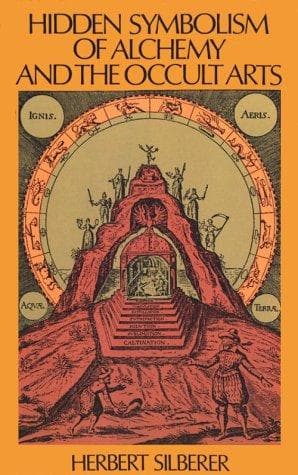
Hidden Symbolism of Alchemy and the Occult ArtsSilberer, Herbert
Religion
Hidden Symbolism of Alchemy and the Occult Arts
Silberer, Herbert
Alchemy; Society of Rosicrucians; Symbolism (Psychology)
Irenæus writes: “... The fire of nature assimilates all that it nourishes
to its own likeness, and then our mercury or menstruum vanishes, that is,
it is swallowed by the solar nature [The soul of man dissolves and is
taken up by the divine or All Soul] and all together make but one
universal mercury [All Soul] by intimate union. And this mercury is the
material principle of the Stone; for formerly, when it was compounded of
three mercuries, [namely, when they thought they had to distinguish
spirit, soul and body, or some other division in it] then Soul, world and
God were, for example, to be thought of, or as they are called in
Soeta-svatara-Upanishad V, Enjoyer, Object of Enjoyment, and Inciter.
As eternal cause contains that trinity.
Whoever finds in it the Brahma as the kernel,
Resolves himself in it as a goal, and is freed from birth.”
Cf. also Deussen, Syst. d. Ved., p. 232, and Sutr. d. Ved., pp. 541 ff.:
“Frequently we are told of the connection of the highest with the
individual soul, and then again of a splitting up [conditioned by them]
inside the Brahma, by virtue of which their two parts are mutually opposed
and limited. Both of these things happen, however, only from the
standpoint of the distinctions [upadhi].... There were two which were
superficial (in that they formed an unjustified opposition) and the third
essential to Sol and Luna only, not to the Stone; for nature would produce
these two out of it by artificial decoction.... [These distinctions depend
on ignorance, after throwing off which the individual is one with the
highest. The connection of the individual soul with Brahman is in truth
its entering into its own self, and the division in Brahma is as unreal as
that between space in general and space within the body.] But when the two
perfect bodies are dissolved [prepared for the mystical work] they are
transmuted with the mercury that dissolved them, and then there is no more
repugnancy in it; then there is no longer a distinction between
superficial and essential. And this is that one matter of the stone, that
one thing which is the subject of all wonders. When thou art come to this
then shalt thou no more discern a distinction between the Dissolver [God]
and the dissolved [soul] ... and the color of the ripe sulphur [the divine
nature] inseparably united to it will tinge your water [soul].” Irenæus
says that the two bodies, Sol and Luna, are compared by the alchemists to
two mountains, first because they are found in mountains, and second by
way of opposition: “For where mountains are highest above ground, there
they lie deepest underground,” and he adds: “The name is not of so much
consequence, take the body which is gold [i.e., here the consummate man]
and throw it into mercury, such a mercury as is bottomless [infinite],
that is, whose center it can never find but by discovering its own.” (H.
A., 283 ff.)
Public-domain text, read in full here on John Shaqi.
Reviews
Reviews
No reviews yet
Be the first to share your thoughts on this work.
Elsewhere in the archive
Join the Discussion
Join the discussion
Sign in to leave a comment or review.
Sign InorCreate an account