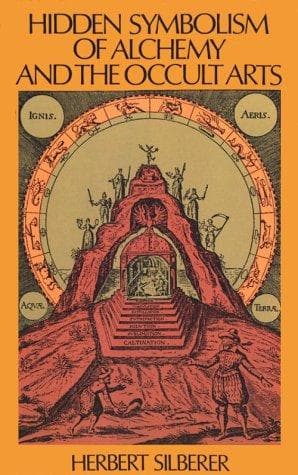
Hidden Symbolism of Alchemy and the Occult ArtsSilberer, Herbert
Religion
Hidden Symbolism of Alchemy and the Occult Arts
Silberer, Herbert
Alchemy; Society of Rosicrucians; Symbolism (Psychology)
Arabi sings in his ode on man’s becoming godlike: “[1] O thou ancient
temple. A light has arisen for thee (you) that gleams in our hearts. [2]
To thee I lament the wilderness that I have traversed, and in which I have
poured forth an unlimited flood of tears. [3] Neither at dawn nor at dusk
do I get repose. From morning until evening I fare on my way without
ceasing. [4] The camels go forth on their journey at night; even if they
have injured their feet, they still hasten. [5] These (mighty) riding
camels bore us to you (probably God) with passionate longing, although
they did not hope to attain the goal....” The riding camels signify the
longing of the mystics for God. “It seeks and strives ceaselessly,
although its powers are drained by the difficulties of the search.”
(Horten, l. c., p. 16 ff.)
Many degrees or stations are to be gone over on the difficult way, yet
zeal is to abide constant in all circumstances. [The idea of the ladder
set up to heaven, of steps, etc., is universal in religions.] In general
seven such steps are distinguished. In Khunrath, e.g., the citadel of
Pallas has seven steps. Paracelsus (De Natura Rerum, VIII), following a
favorite custom, gives seven operations of the work. “... It is now
necessary to know the degrees and steps to transmutation, and how many
they are. These steps are then no more than seven. Although some count
still more, it should not be so. For the most important steps are seven.
The further ones, however, which might be reckoned as steps are comprised
under the others, which are as follows: calcination [sublimation],
dissolution, putrefaction, distillation, coagulation, and tincturing.
Whoever passes over these seven steps and degrees comes to such a
marvelous place, where he sees much mystery and attains the transmutation
of all natural things.” In the “Rosarium” of Johannes Daustenius [Chap.
XVII] the seven steps are represented as follows: “And then the corpus [1]
is a cause that the water is retained. The water [2] is the cause of
preserving the oil so that it is not ignited on the fire, and the oil [3]
is the cause of retaining the tincture, and the tincture [4] is a cause of
the colors appearing, and the color [5] is a cause of showing the white,
and the white [6] is a cause of keeping every volatile thing [7] from
being no longer volatile.” It amounts to the same thing when Bonaventura
describes septem gradus contemplationis [seven steps of contemplation],
and David of Augsburg [13th century] the “seven steps of prayer.” Boehme
recognizes 7 fountain spirits that constitute a certain gradation and in
the yoga we also find 7 steps, which are described in the “Yoga Vasistha”
(cf. Hath. Prad., pp. 2 ff). It may easily happen that the domination of
the number 7 is to be derived from the infusion of the scientific
doctrines (7 planets, 7 metals, 7 tones in the diatonic scale) and yet it
may depend on an actual correspondence in the human psyche with nature—who
Public-domain text, read in full here on John Shaqi.
Reviews
Reviews
No reviews yet
Be the first to share your thoughts on this work.
Elsewhere in the archive
Join the Discussion
Join the discussion
Sign in to leave a comment or review.
Sign InorCreate an account