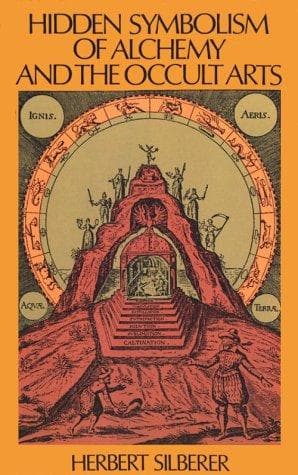
Hidden Symbolism of Alchemy and the Occult ArtsSilberer, Herbert
Religion
Hidden Symbolism of Alchemy and the Occult Arts
Silberer, Herbert
Alchemy; Society of Rosicrucians; Symbolism (Psychology)
If one put into the center of vision, as goal of the work, the recovery of
the harmonious state of the soul, one might express oneself about the
three primary colors as follows: The paradisical state demands absolute
freedom from conflict. We can attain this only by completely withdrawing
from the external world whatever causes conflict in connection with the
external world, so that there comes to pass with regard to it, a
thorough-going indifference. This indifference is the black. The freedom
from conflict (guiltlessness) in the now newly beginning life is the
white. Previously, at the disintegration (rotting) of the material, one
constituent part was removed and taken away. That is, the libido becomes
free (love). It is gradually alloyed with the white material, which is dry
(thirsty without thirst); sown in the white ground. Life is without
conflict now drenched with love, red. This true red thus attained is
permanent because it is produced [in contrast to mere instruction] from
the heart of hearts, the roots of innermost feeling, which is subjected to
no usury.
The mystical procedure can be realized in different degrees of intensity.
The lowest degree is as a program with the mere result of a stimulation;
the highest degree is a final transmutation of the psyche. If this goal is
attained in life, we have acquired the terrestrial stone. In contrast, the
celestial stone belongs with the eschatological concepts and the celestial
tincture is the apokatastasis.
It is an interesting question whether the resolution of conflicts, with
evasion of the process in the outer world, cannot be accomplished
subjectively, by battles with symbols (personifications) and in symbols,
thus amounting to an abbreviation of the process. Theoretically this is
not impossible, for the conflicts do not indeed lie in the external world,
but in our emotional disposition towards it; if we change this disposition
by an inner development, the external world has a different value for the
libido.
“The projection into the cosmic is the primal privilege of the libido, for
it naturally enters into our perception through the gates of all the
senses and apparently from without, and actually, in the form of the
pleasure and pain qualities of perception. These, as we all know, we
attribute without further deliberation to the object, and their cause, in
spite of philosophical deliberation, we are continually inclined to look
for in the object, while the object is often hopelessly innocent of it.”
(Jung, in Jb. ps. F., III, p. 222; with which compare the Freudian
transference concept and Ferenczi’s essay on “Introjektion und
Ubertragung,” in Jb. ps. F., I, p. 422.) Jung calls attention to the
frequently described immediate projection of the libido in love poetry, as
in the following example from the Edda (H. Gering):
“In Gymer’s Courtyard I saw walking
The maiden, dear to me;
From the brightness of her arms glowed the heavens,
And all the eternal sea.”
Public-domain text, read in full here on John Shaqi.
Reviews
Reviews
No reviews yet
Be the first to share your thoughts on this work.
Elsewhere in the archive
Join the Discussion
Join the discussion
Sign in to leave a comment or review.
Sign InorCreate an account