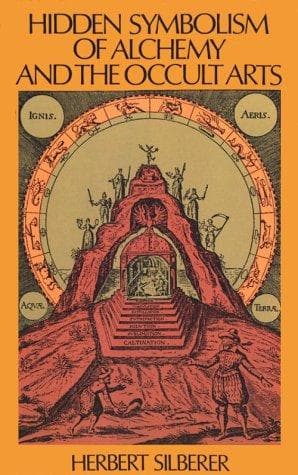
Hidden Symbolism of Alchemy and the Occult ArtsSilberer, Herbert
Religion
Hidden Symbolism of Alchemy and the Occult Arts
Silberer, Herbert
Alchemy; Society of Rosicrucians; Symbolism (Psychology)
“Knowest thou not, I was asked, that the law of sin has the mastery as
long as it [the body with its selfish tendencies] lives? So that the
spirit clearly bore witness and gave me to understand that nothing could
make me worthy of this marriage with the Lamb [unio mystica] except an
absolute death, since he wedded only the maidenly spirit, to be one flesh
with him, [H in H, F against F, etc.] and by so doing changed it into his
own pure manhood. [Humanity.] And this is the generation or birth to an
actively self-sufficient being, which rises out of the old one. For just
as the grain of wheat perishes or dies in the earth and comes into a new
life, just so it goes also with the arising and the growing up of the new
creation, which in truth is Christ our life, whose appearance will put an
end to the sins in us. For, dear one, what has brought on the curse, care,
trouble, misery, weaknesses, which press and torture the poor man in this
fallen state of his but the departing from God? And as long as he is in
this condition, he is a debtor to sin and under its dominion; which
subjects him to all affliction and misery, which are wont to follow the
footsteps of those who live in the elemental flesh. Now without doubt it
is good and joyful tidings to hear of a possibility of drawing out and
putting off this body of sins; and in truth the prophet who has arisen in
me has prophesied that such a day was at hand. Be dismayed at it, ye that
are the wounders and despisers of this grace; which I see is now near
being revealed, for the bridal garments are being prepared ... [Cf. the
end of the parable.] O Wisdom, the preparation and ordering of the bridal
garments is given in charge to you alone, which shall be of divers colors,
with which the king’s daughter, [Analogue of the king’s son, the improved
son figure of the parable.] who is entrusted to thy teaching and
instruction, may be distinguished from all others, and known [as
redeemed].” (L. G. B., I, pp. 51 ff., wherewith the magic journey is
ended.)
Thus there is a confident tone, a hope in that which loses itself in the
infinite. But Leade suspects that it is an unattainable ideal and knows
what regulative import it has: “Ah, who up to this hour has traveled so
far, and what are all our realized gifts until we have reached this goal
[union with the Divinity]. Can our plummet even sound it and explore in
the deep abyss, the matchless wonder of the immeasurable being? And
because the revolving wheel of my spirit has found no rest in all that it
has seen, known, possessed and enjoyed, it stretched its errant senses
continuously towards what was still held back, and kept, by the strong
rock of omnipotence; to struggle towards which with a fresh attack I
resolutely determined, and would be sent away with nothing less than the
kingdom and the ruling power of the Holy Ghost.” (L. G. B., I, p. 87.)
Public-domain text, read in full here on John Shaqi.
Reviews
Reviews
No reviews yet
Be the first to share your thoughts on this work.
Elsewhere in the archive