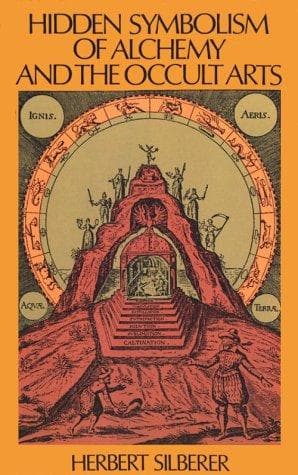
Hidden Symbolism of Alchemy and the Occult ArtsSilberer, Herbert
Religion
Hidden Symbolism of Alchemy and the Occult Arts
Silberer, Herbert
Alchemy; Society of Rosicrucians; Symbolism (Psychology)
Note F (305). Jung (Jb., Ill, p. 171) refers to Maeterlinck’s “inconscient
supérieur” (in “La Sagesse et la Destinée”) as a prospective potentiality
of subliminal combinations. He comments on it as follows: “I shall not be
spared the reproach of mysticism. Perhaps the matter should none the less
be pondered: doubtless the unconscious contains the psychological
combinations that do not reach the liminal value of consciousness.
Analysis resolves these combinations into their historical determinants
for that is one of the essential tasks of analysis, i.e., to render
powerless by disconnecting them, the obsessions of the complexes that are
concurrent with the purposeful conduct of life. History is ignorant of two
kinds of things: what is hidden in the past and what is hidden in the
future. Both are probably to be attained with a certain measure of
probability, the former as a postulate, the latter as a historical
prognosis. In so far as to-morrow is contained in to-day, and all the warp
of the future already laid, a deepened knowledge of the present could make
possible a more or less wide-reaching and sure prognosis of the future. If
we transfer this reasoning, as Kant has already done, to the psychologic,
the following things must result; just as memory traces, which have
demonstrably become subliminal, are still accessible to the unconscious,
so also are certain very fine subliminal combinations showing a forward
tendency, which are of the greatest possible significance for future
occurrences in so far as the latter are conditioned by our psychology. But
just as the science of history troubles itself little about the future
combinations which are rather the object of politics, just so little are
the psychological combinations the object of the analysis, but would be
rather the object of an infinitely refined psychological synthesis, which
should know how to follow the natural currents of the libido. We cannot do
this, but probably the unconscious can, for the process takes place there,
and it appears as if from time to time in certain cases significant
fragments of this work, at least in dreams, come to light, whence came the
prophetic interpretation of dreams long claimed by superstition. The
aversion of the exact [sciences] of to-day against that sort of
thought-process which is hardly to be called phantastic is only an
overcompensation of the thousands of years old but all too great
inclination of man to believe in soothsaying.”
Public-domain text, read in full here on John Shaqi.
Reviews
Reviews
No reviews yet
Be the first to share your thoughts on this work.
Elsewhere in the archive
Join the Discussion
Join the discussion
Sign in to leave a comment or review.
Sign InorCreate an account