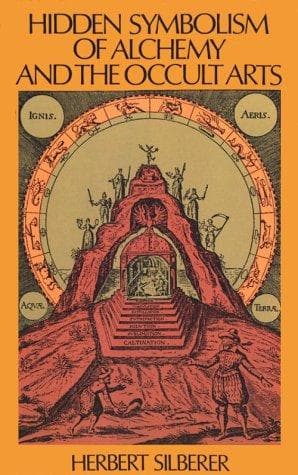
Hidden Symbolism of Alchemy and the Occult ArtsSilberer, Herbert
Religion
Hidden Symbolism of Alchemy and the Occult Arts
Silberer, Herbert
Alchemy; Society of Rosicrucians; Symbolism (Psychology)
The dismemberment, with final loss of the phallus, will be clearly
recognized as a castration. The tearing out of the eye is similarly to be
regarded as emasculation. This motive is found as self-punishment for
incest, at the close of the Œdipus drama. On the dismemberment of Osiris
as a castration, Rank writes (Inz. Mot., p. 311): “The characteristic
phallus consecration of Isis shows us that her sorrow predominantly
concerns the loss of the phallus, (and it also is expressed in the fact
that according to a later version, she is none the less in a mysterious
manner impregnated by her emasculated spouse), so on the other hand the
conduct of the cruel brother shows us that in the dismemberment he was
particularly interested in the phallus, since that indeed was the only
thing not to be found, and had evidently been hidden with special
precautionary measures. Indeed both motivations appear closely united in a
version cited by Jeremias (Babylonisches in N. T., p. 721), according to
which Anubis, the son of the adulterous union of Osiris with his sister
Nephthys, found the phallus of Osiris, dismembered by Typhon with 27
assistants, which Isis had hidden in the coffin. Only in this manner could
the phallus from which the new age originated, escape from Typhon. If this
version clearly shows that Isis originally had preserved in the casket the
actual phallus of her husband and brother which had been made
incorruptible and not merely a wooden one, then on the other hand the
probability increases that the story originally concerns emasculation
alone because of the various weakening and motivating attempts that meet
us in the motive of the dismemberment.”
In the form of the Osiris saga the dismemberment appears, however, not
merely as emasculation. More clearly recognizable is also the separation
of the primal parents, the dying out of the primal being resulting in a
release of the primal procreative power for a fresh world creation. It is
a very interesting point that in one of the versions a mighty tree grows
out of the corpse of Osiris. Later on we become acquainted for the first
time with the potent motive of the restoration of the dismembered one, the
revivification of the dead.
For example, in the Finnish epic, Kalevala, Nasshut throws the
Lemminkainen into the waters of the river of the dead. Lemminkainen was
dismembered, but his mother fished out the pieces, one of which was
missing, put them together and brought them to life in her womb. According
to Stucken’s explanation we recognize in Nasshut a father image, in
Lemminkainen a son image. In the tradition no relationship between them is
mentioned. That is, however, a “Differentiation and attenuation of traits,
which is common in every myth-maker.” (S. A. M., p. 107.)
Public-domain text, read in full here on John Shaqi.
Reviews
Reviews
No reviews yet
Be the first to share your thoughts on this work.
Join the Discussion
Join the discussion
Sign in to leave a comment or review.
Sign InorCreate an account