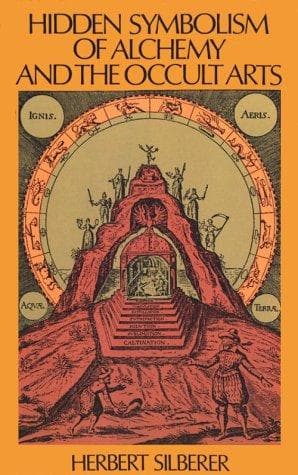
Hidden Symbolism of Alchemy and the Occult ArtsSilberer, Herbert
Religion
Hidden Symbolism of Alchemy and the Occult Arts
Silberer, Herbert
Alchemy; Society of Rosicrucians; Symbolism (Psychology)
From the lower Austrian peasantry Rank takes the following (Wurth. Zf. d.
Mythol., IV, 140): “Far, far off in the sea there stands a tree near which
the babies grow. They hang by a string on the tree and when the baby is
ripe the string breaks and the baby floats off. But in order that it
should not drown, it is in a box and in this it floats away to the sea
until it comes into a brook. Now our Lord God makes ill a woman for whom
he intended the baby. So a doctor is summoned. Our Lord God has already
suggested to him that the sick woman will have a baby. So he goes out to
the brook and watches for a long time until finally the box with the baby
comes floating in, and he takes it up and brings it to the sick woman. And
this is the way all people get their babies.”
I call attention briefly also to the legend of the fountain of youth, to
the mythical and naturalistic ideas of water as the first element and
source of all life, and to the drink of the gods (soma, etc.) Compare also
the fountain in the verses previously quoted.
The bridal pair in the parable (Sec. 11) walk through the garden and the
bride says they intend in their chamber to “enjoy the pleasures of love.”
They have picked many fragrant roses. Bear in mind the picking of
strawberries in Mr. T.’s dream. The garden becomes a bridal chamber. The
rain mentioned somewhat earlier, is a fructifying rain; it is the water of
life that drops down upon Mother Earth. It is identical with the sinking
trees of Mrs. Delta’s dream, with the power of creation developed by the
wanderer, with the mythical drink of the gods, ambrosia, soma. We shall
now see the wanderer ascend or descend to the source of this water of
life. To gain the water of life it is generally in myths necessary to go
down into the underworld (Ishtar’s Hell Journey), into the belly of a
monster or the like. Remember, too, that the wanderer puts himself back in
his mother’s womb. There is indeed the origin of his life. The process is
still more significantly worked out in the parable.
The wanderer (Section 11, after the garden episode) comes to the mill. The
water of the mill stream also plays a significant part in the sequel. The
reader will surely have already recognized what kind of a mill, what kind
of water is meant. I will rest satisfied with the mere mention of several
facts from folklore and dream-life.
Public-domain text, read in full here on John Shaqi.
Reviews
Reviews
No reviews yet
Be the first to share your thoughts on this work.
Elsewhere in the archive
Join the Discussion
Join the discussion
Sign in to leave a comment or review.
Sign InorCreate an account