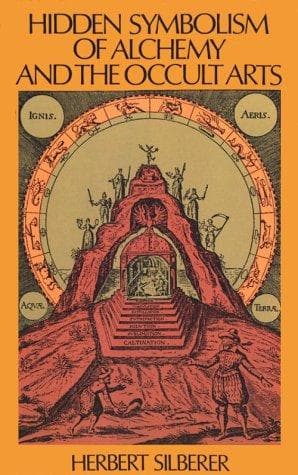
Hidden Symbolism of Alchemy and the Occult ArtsSilberer, Herbert
Religion
Hidden Symbolism of Alchemy and the Occult Arts
Silberer, Herbert
Alchemy; Society of Rosicrucians; Symbolism (Psychology)
Nork (Myth. d. Volkss., p. 301 f.) writes that Fenja is of the female sex
in the myth (Horwendil) which we must infer from her occupation, for in
antiquity when only hand mills were as yet in use, women exclusively did
this work. In symbolic language, however, the mill signifies the female
organ (μυλλός from which comes _mulier_) and as the man is the miller, the
satirist Petronius uses _molere mulierem_ = (grind a woman) for coitus,
and Theocritus (Idyll, IV, 48) uses μύλλω (I grind) in the same sense.
Samson, robbed of his strength by the harlot, has to grind in the mill
(Judges XVI, 21) on which the Talmud (Sota fol. 10) comments as follows:
By the grinding is always meant the sin of fornication (Beischlaf).
Therefore all the mills in Rome stand still at the festival of the chaste
Vesta. Like Apollo, Zeus, too, was a miller (μυλεύς, Lykophron, 435), but
hardly a miller by profession, but only in so far as he presides over the
creative lifegiving principle of the propagation of creatures. It is now
demonstrated that every man is a miller and every woman a mill, from which
alone it may be conceived that every marriage is a milling (jede
Vermählung eine Vermehlung), etc. Milling (vermehlung) is connected with
the Roman confarreatio (a form of marriage); at engagements the Romans
used to mingle two piles of meal. In the same author (p. 303 and p. 530):
Fengo is therefore the personification of grinding, the mill (Grotti) is
his wife Gerutha, the mother of Amleth or Hamlet. Grotti means both woman
and mill. Greeth is only a paraphrase of woman. He continues, “Duke Otto,
Ludwig of Bavaria’s youngest son, wasted his substance with a beautiful
miller’s daughter named Margaret, and lived in Castle Wolfstein.... This
mill is still called the Gretel mill and Prince Otto the Finner” (Grimm,
D. S., No. 496). Finner means, like Fengo, the miller [Fenja—old Norman? =
the milleress], for the marriage is a milling [Vermählung ist eine
Vermehlung], the child is the ground grain, the meal.
The same writer (Sitt. u. Gebr., p. 162): “In concept the seed corn has
the same value as the spermatozoon. The man is the miller, the woman the
mill.”
In Dulaure-Krauss-Rieskel (Zeugung i. Glaub usw. d. Völk., p. 100 ff.) I
find the following charm from the writings of Burkhard, Bishop of Worms:
“Have you not done what some women are accustomed to do? They strip
themselves of clothes, they anoint their naked bodies with honey, spread a
cloth on the ground, on which they scatter grain, roll about in it again
and again, then collect carefully all the grains, which have stuck on
their bodies, and grind them on the mill stone which they turn in a
contrary direction. When the corn is ground into meal, they bake a loaf of
it, and give it to their husbands to eat, so that they become sick and
die. When you have done this you will atone for it forty days on bread and
water.”
Killing is the opposite of procreating, therefore the mill is here turned
in reverse direction.
Public-domain text, read in full here on John Shaqi.
Reviews
Reviews
No reviews yet
Be the first to share your thoughts on this work.
Elsewhere in the archive
Join the Discussion
Join the discussion
Sign in to leave a comment or review.
Sign InorCreate an account