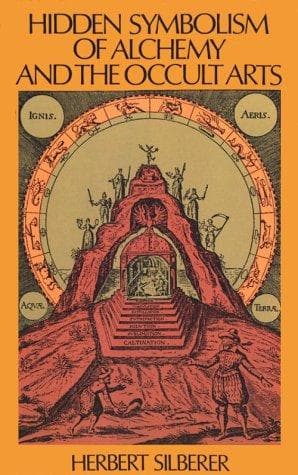
Hidden Symbolism of Alchemy and the Occult ArtsSilberer, Herbert
Religion
Hidden Symbolism of Alchemy and the Occult Arts
Silberer, Herbert
Alchemy; Society of Rosicrucians; Symbolism (Psychology)
In one respect we are therefore better off, but in another we are much
worse off. For the matter in which we previously worked, the unconscious,
remains approximately the same throughout great periods; the unconscious
of the wanderer is in its fundamentals not very different from that of a
man of to-day or from that of Zosimos. [Zosimos is one of the oldest
alchemistic writers of whom we have any definite knowledge—about the 4th
century.] It is the soul of the race that speaks, its “humanity.” Much
more swiftly, on the contrary, does objective knowledge change in the
course of time and the forms also in which this knowledge is expressed.
From this point of view the conscious is more difficult of access than the
unconscious. And now we have to face a system so very far removed from our
way of thinking as the alchemistic.
Fortunately I need not regard it as my duty to explain the parable so
completely in the alchemistic sense that any one could work according to
it in a chemical laboratory. It is much more suitable to our purpose if I
show in general outline only how we must arrange the leading forms and
processes of the parable to accord with the mode of thinking peculiar to
alchemy. If I should succeed in doing so clearly, we should already have
passed a difficult stage. Then for the first time I might venture
further—to the special object of this research. But patience! We have not
yet gone so far.
First of all it will be necessary for me to draw in a few lines a sketch
of how, in the most flourishing period of alchemy, the accomplishment of
the Great Work was usually described. In spite of the diversity of the
representations we find certain fundamental principles which are in
general firmly established. I will indicate a few points of this iron-clad
order in the alchemic doctrine.
There is, in the first place, the central idea of the interaction or the
coöperation of two things that are generally called man and woman, red and
white, sun and moon, sulphur and mercury. We have already seen in Ibn Sina
that the metals consist of the combination of sulphur and mercury. Even
earlier the interaction of two parts were figuratively called
impregnation. Both fuse into one symbol, and indeed so much the more
readily, as it probably arose as the result of analogous thoughts,
determined by a sexual complex. Also there occurs the idea that we must
derive a male activity from the gold, a female from the silver, in order
to get from their union that which perfects the mercury of the metals.
That may be the reason that, for the above mentioned pair that is to be
united, the denotation gold and silver ([Symbol: Gold] and [Symbol:
Silver]) prevailed. Red and white = man and woman (male and female
activity), we found in the parable also when studied psychoanalytically.
In the “Turba philosophorum” “the woman is called Magnesia, the white, the
man is called red, sulphur.”
Public-domain text, read in full here on John Shaqi.
Reviews
Reviews
No reviews yet
Be the first to share your thoughts on this work.
Elsewhere in the archive
Join the Discussion
Join the discussion
Sign in to leave a comment or review.
Sign InorCreate an account