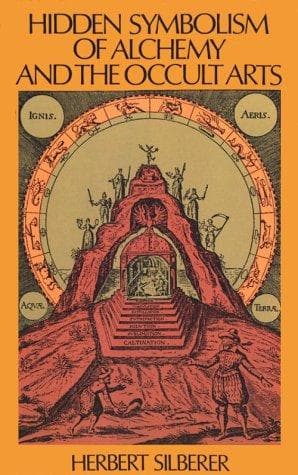
Hidden Symbolism of Alchemy and the Occult ArtsSilberer, Herbert
Religion
Hidden Symbolism of Alchemy and the Occult Arts
Silberer, Herbert
Alchemy; Society of Rosicrucians; Symbolism (Psychology)
Arnold (Ros., I, 9): “In so far as the substances here do not become
incorporeal or volatile, so that there is no more substance [as such
therefore destroyed] you will accomplish nothing in your work.”
The red man and the white woman, called also red lions and white lilies,
and many other names, are united and cooked together in a vessel, the
philosophical Egg. The combined material becomes thereby gradually black
(and is called raven or ravenhead), later white (swan); now a somewhat
greater heat is applied and the substance is sublimated in the vessel (the
swan flies up); on further heating a vivid play of colors appears (peacock
tail or rainbow); finally the substance becomes red and that is the
conclusion of the main work. The red substance is the philosopher’s stone,
called also our king, red lion, grand elixir, etc. The after work is a
subsequent elaboration by which the stone is given still more power,
“multiplied” in its efficiency. Then in “projection” upon a baser metal it
is able to tincture immense amounts of it to gold. [In the stage of
projection the red tincture is symbolized as a pelican. The reason for
this will be given later.] If the main work was interrupted at the white
stage, instead of waiting for the red, then they got the white stone, the
small elixir, with which the base metals can be turned into silver alone.
We have spoken just now of the main work and the after work. I mention for
completeness that the trituration and purification, etc., of the
materials, which precedes the main work, is called the fore work. The
division is, however, given in other ways besides.
Armed with this explanation we can venture to look for the alchemic
hieroglyphs in our parable. I must beg the reader to recall the main
episodes.
In the wanderer we have to conceive of a man who has started out to learn
the secret of the great work. He finds in the forest contradictory
opinions. He has fallen deep into errors. The study, although difficult,
holds him fast. He cannot turn back (Sec. 1). So he pursues his aim still
further (Sec. 2) and thinks he has now found the right authorities (Sec.
3) that can admit him to the college of wisdom. But the people are not at
one with each other. They also employ figurative language that obscures
the true doctrine, and which, contrasted with practice, is of no value. (I
mention incidentally that the great masters of the hermetic art are
accustomed to impress on the reader that he is not to cling to their words
but measure things always according to nature and her possibilities.) The
elders promise him indeed the revelation of important doctrines but are
not willing to communicate the beginning of the work (Sec. 5, 6,
preparation for the fight with the lion). That is a rather amusing trait
of hermetic literature.
Public-domain text, read in full here on John Shaqi.
Reviews
Reviews
No reviews yet
Be the first to share your thoughts on this work.
Elsewhere in the archive
Join the Discussion
Join the discussion
Sign in to leave a comment or review.
Sign InorCreate an account