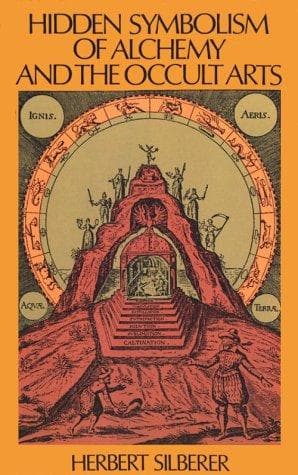
Hidden Symbolism of Alchemy and the Occult ArtsSilberer, Herbert
Religion
Hidden Symbolism of Alchemy and the Occult Arts
Silberer, Herbert
Alchemy; Society of Rosicrucians; Symbolism (Psychology)
The homunculus topic is exceedingly interesting. Unfortunately I cannot in
the space of this book go into it thoroughly. I shall do so in another
place.
Section III.
The Hermetic Art.
Any one that makes a thorough study of the alchemistic literature must be
struck with the religious seriousness that prevails in the writings of the
more important authors. Every “master” who enjoyed the highest honor among
his fellows in the hermetic art has a certain lofty manner that keeps
aloof from the detailed description of chemical laboratory work, although
they do not depart from the alchemistic technical language. They obviously
have a leaning toward some themes that are far more important than the
production of a chemical preparation can be, even if this is a tincture
with which they can tinge lead into gold. Looking forth to higher nobler
things, these authors, whose homely language frequently touches our
feelings deeply, make the reader notice that they have nothing in common
with the sloppy cooks who boil their pots in chemical kitchens, and that
the gold they write about is not the gold of the multitude; not the venal
gold that they can exchange for money. Their language seems to sound as if
they said, “Our gold is not of this world.” Indeed they use expressions
that can with absolute clearness be shown to have this sense. Authors of
this type did not weary of enjoining on the novices of the art, that
belief, scripture and righteousness were the most important requisites for
the alchemistic process. [With the sloppers it was indeed a prime
question, how many and what kinds of stoves, retorts, kettles, crucibles,
ores, fires, etc., in short, what necessary implements they needed, for
the great work.]
He whose eyes are open needs no special hints to see, in reading, that the
so-called alchemistic prescriptions did not center upon a chemical
process. A faint notion of the circumstance that even in their beginnings,
alchemistic theories were blended with cosmogonic and religious ideas,
must make it quite evident that, for example, in the famous Smaragdine
Tablet of Hermes [Its real author is unknown.] a noble pillar of alchemy,
something more must be contained than a mere chemical recipe. The language
of the Smaragdine tablet is notoriously the most obscure that the hermetic
literature has produced; in it there are no clear recommendations to
belief or righteousness; and yet I think that an unprejudiced reader, who
was not looking specially for a chemical prescription, would perceive at
least a feeling for something of philosophy or theology.
Public-domain text, read in full here on John Shaqi.
Reviews
Reviews
No reviews yet
Be the first to share your thoughts on this work.
Elsewhere in the archive
Join the Discussion
Join the discussion
Sign in to leave a comment or review.
Sign InorCreate an account