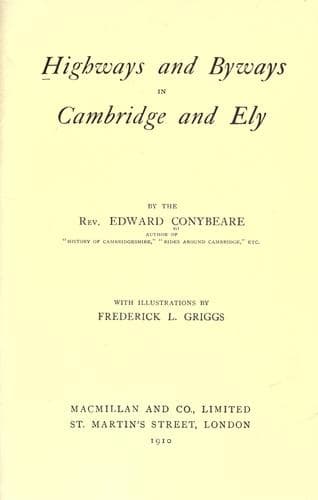
Highways and Byways in Cambridge and ElyConybeare, John William Edward
History
Highways and Byways in Cambridge and Ely
Conybeare, John William Edward
Cambridgeshire (England) -- Description and travel; Isle of Ely (England) -- Description and travel
Till lately the tower of Great St. Mary's was a historical record of
the stirring scenes amid which it arose, for it was slowly built
during the course of no fewer than 120 years, being begun in the last
decade of the fifteenth century and finished in the first of the
seventeenth. Thus the lower stages were of Perpendicular Gothic, the
higher of Renaissance style. Unhappily the Victorian restorers took it
in hand, and rebuilt the top as, in their view, it would have been
built had it been completed without this long delay, so that all
historical interest is now lost. It contains a fine peal of twelve
bells, on which sound the famous chimes composed in 1790 by Dr.
Jowett,[84] tutor of Trinity Hall, which, since their adoption in the
Westminster clock tower, have spread so widely throughout the country
and the Empire. Their cadences are:
1st Quarter 1236
2nd " 3126, 3213
3rd " 1326, 6213, 1236
4th " 3126, 3213, 1326, 6213
[Footnote 84: It is hard upon Dr. Jowett that his name should have
come down to posterity associated, not with this real contribution to
the gladness of the world, but with a satirical quatrain on the tiny
plot which he reclaimed from the street in the angle of Trinity Hall
adjoining Clare:
"A little garden little Jowett made,
And fenced it with a little palisade;
And would you know the mind of little Jowett,
This little garden will a little show it."]
The hour is struck on the tenor bell. These bells are of eighteenth
century date: two more have been added since.
[Illustration: _Peas Hill._]
Great St. Mary's, for all its University connection, still remains
what it was before the University came into being, a Parish Church;
its Parish consisting of the Market Place, which opens out to the east
of it, and is called locally "Market Hill." Whence this curious use of
the latter word arose is not known, but it is immemorial at Cambridge
for any expansion of a street into something wider. Besides Market
Hill, there are the smaller spaces of Peas Hill and St. Andrew's Hill.
All are utterly flat; yet, so potent is the word in the imagination of
the Cambridge townsfolk, that such expressions as "I wonder the Hill
don't fall down upon you" may be overheard in market disputes. Market
Hill is not very large for its purpose even now; but till the
nineteenth century it was much smaller, with more than one range of
houses encumbering its area. On the southern side stands the
Guildhall, a far from imposing structure, and in the centre rises the
fountain supplied by the water of Hobson's Conduit, as described in
our first chapter. The present structure was erected in 1855, the
earlier one (put up in 1614) being then removed to its present
position at the junction of Lensfield Road and Trumpington Road.[85]
Public-domain text, read in full here on John Shaqi.
Reviews
Reviews
No reviews yet
Be the first to share your thoughts on this work.
Elsewhere in the archive
Join the Discussion
Join the discussion
Sign in to leave a comment or review.
Sign InorCreate an account