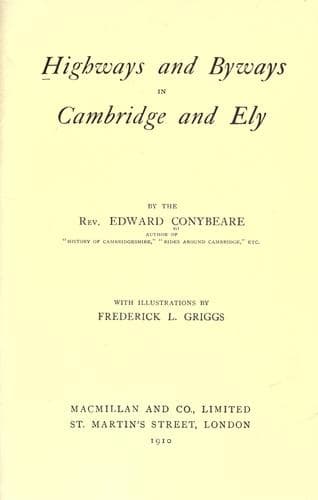
Highways and Byways in Cambridge and ElyConybeare, John William Edward
History
Highways and Byways in Cambridge and Ely
Conybeare, John William Edward
Cambridgeshire (England) -- Description and travel; Isle of Ely (England) -- Description and travel
Behind the Round Church rise the sumptuous rooms of the "Union[89]
Society," a University club primarily instituted as an association for
the cultivation of oratory amongst undergraduates, which has now added
to its central debating hall a library, dining-room, smoking-room, and
the other adjuncts of a first-class club. Here, on each Tuesday
evening during Term, debates are held, usually on current political or
social situations, theological polemics being strictly barred. When
the Society was first instituted, in the early decades of the
nineteenth century, current politics were also prohibited (by the
University authorities), and could only be discussed under a decent
veil of reference to antiquity. But the comparative merits of the
causes championed by Caesar and Pompey, or by the Cavaliers and
Roundheads, were so easily made to apply to the burning questions of
the day, that the prohibition speedily become obsolete. Many a
well-known Parliamentary orator has won his first fame on the benches
of the Union, Lord Macaulay being a notable example. His perfervid
outpourings here swept away all opposition, and his friend and
contemporary, Mackworth Praed, records how the issue of any debate is
irrevocably decided--
"When the Favourite comes,
With his trumpets and drums,
And his arms, and his metaphors, crossed."
[Footnote 89: So called because in union with the twin Society at
Oxford; members of each having, _ipso facto_, all the privileges of
membership in the other.]
Leaving the Round Church behind us, and proceeding westwards, we pass
the Church of St. Clement, with its inscription DEUM COLE ("Worship
God"), which has nothing to detain us, and shortly arrive at "the
Great Bridge,"[90] that famous passage of the river to which the town
owes its name and its very existence. It can never have been an
imposing structure, in spite of its high-sounding title, and is now
represented by an exceedingly commonplace iron span. But, as the only
passage of the Cam approachable by an army, in fore-drainage days, for
many a long mile, it was of old a strategic point of first-class
importance, and more than once played a notable part in English
history. Its possession by the anti-monarchical forces shattered the
last efforts both of King John and of Charles the First, and brought
about, as we shall see, the speedy ruin and death of the former.
[Footnote 90: So called to distinguish it from the smaller town
bridges by Newnham Mill and Garret Hostel.]
To the North of the Bridge, and on the Eastern bank of the River, is
the last of the many "Hithes" (or Quays), of which we read so much in
connection with old Cambridge, remaining in actual use for traffic.
Here we may to this day see exemplified the ancient local proverb,
"Here water kindleth fire;" for barges loaded with fire-wood and turf
from the fens still discharge their cargoes at this spot.
Public-domain text, read in full here on John Shaqi.
Reviews
Reviews
No reviews yet
Be the first to share your thoughts on this work.
Elsewhere in the archive
Join the Discussion
Join the discussion
Sign in to leave a comment or review.
Sign InorCreate an account