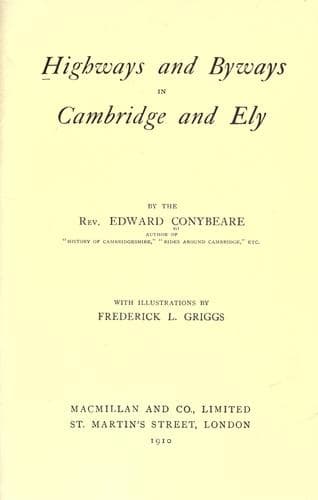
Highways and Byways in Cambridge and ElyConybeare, John William Edward
History
Highways and Byways in Cambridge and Ely
Conybeare, John William Edward
Cambridgeshire (England) -- Description and travel; Isle of Ely (England) -- Description and travel
Pepys had been a student here, and his portrait, by Lely, hangs in the
Hall. So does that of another distinguished Magdalene man, Charles
Kingsley, who was in residence 1839 to 1842. College tradition still
records how he used surreptitiously to climb out of the College in the
very early summer mornings, to be off on one of those piscatorial
excursions which he so dearly loved. Another well-known writer
connected with Magdalene is Mr. A. C. Benson, whose "College Window"
was in the ground floor of the Pepysian Library range, on the North
side, looking into the gardens of the Master's Lodge. In these gardens
is a high terraced walk, beneath an old wall. Both terrace and wall
are supposed to be connected with the ancient defences of Cambridge,
but this is not proven.
[Illustration: _St. Peter's Church._]
We have, however, now come to the region where those defences did
actually exist. For beyond this wall to the West rises the steep
slope, partly natural and partly artificial, of the "Castle Hill,"
towering into the great mound on which stood the Norman Keep. This was
built by William the Conqueror; but long before his day the site,
defensible by nature, and commanding the all-important passage of the
river, had been utilised for military purposes. Here, probably, was a
British post, the _Cam-Rhydd_ or "Ford of the Cam," which became the
Roman Camboritum.[93] Here Oliver Cromwell, as commander over the
forces of the "Associated Counties,"[94] set up fortifications which
baffled the gallant effort to retrieve his fallen fortunes made by
Charles the First after the fatal battle of Naseby. Having there left
his matchless infantry, "lying with their pikes charged every way as
when they lived," the unfortunate monarch, with the remains of his
cavalry, broke through the network of the enemies' squadrons in full
pursuit "like hounds after a fresh stag," and made a dash for the
Eastern Counties, "where he had a party forming." Huntingdon he took
by surprise, and "twice affronted the lines of Cambridge." But these
were too strong to be rushed by horse-soldiers, and, as there was no
other passage over the Cam, he had to retire, finally evading his
pursuers, and making his way safely to Oxford, with all the loot
acquired in this raid, "six waggons loaded with money, two thousand
horses, and three thousand head of cattle." And the remembrance of
Anglo-Saxon lines of defence round the site is perpetuated in the name
"Borough," which still clings to it.
[Footnote 93: In spite of the enticing similarity of sound, it is
fairly established that the word Camboritum is not the parent of the
word Cambridge. In mediaeval times we only read of "Granta-bridge."]
[Footnote 94: These were Norfolk, Suffolk, Essex, Cambs, Hunts, Beds
and Herts, which combined to raise a common force (on the
Parliamentary side).]
Public-domain text, read in full here on John Shaqi.
Reviews
Reviews
No reviews yet
Be the first to share your thoughts on this work.
Elsewhere in the archive
Join the Discussion
Join the discussion
Sign in to leave a comment or review.
Sign InorCreate an account