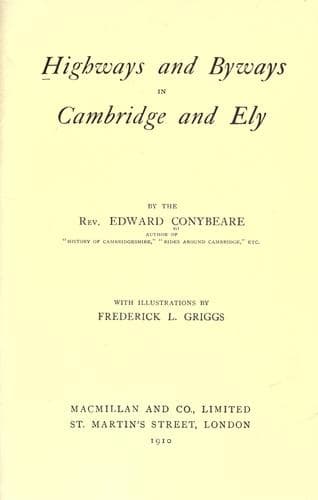
Highways and Byways in Cambridge and ElyConybeare, John William Edward
History
Highways and Byways in Cambridge and Ely
Conybeare, John William Edward
Cambridgeshire (England) -- Description and travel; Isle of Ely (England) -- Description and travel
Immediately to the north of Newnham is Selwyn College, a
denominational institution belonging to the Church of England,
corresponding to Keble College at Oxford, and, like it, recognised by
the University, not indeed as a College, but as a "Public Hostel,"
whose undergraduates are not mere "non-collegiate students." Such
"unattached" students are under a "Censor" and a special syndicate,
and have a centre in the "Fitzwilliam Hall" (close to the museum of
that name), where they have to report themselves daily.
[Illustration: _The Back Court, Jesus College._]
Looking eastwards from the Castle Hill, we see a wide, open green
stretching from the further bank of the river, and beyond it a low
church tower rising amid trees. This is the tower of Jesus College
Chapel, once the Priory Church of St. Radegund. This lady was a
Frankish queen of the sixth century, and a friend of the poet
Venantius, the author of the well-known hymns _Vexilla Regis_ and
_Pange Lingua_. Under her dedication a Benedictine nunnery was founded
here at the beginning of the eleventh century. It was never a large or
wealthy institution, but continued to flourish for four hundred years
and more. In 1455 its account books, still preserved among the
archives of Jesus College, show an income of L70 per annum, equivalent
in purchasing power to some L1,200 at the present value of money.
Every Benedictine nun ranked socially as a gentlewoman, so that this
income needed careful administration to make it suffice for the nine
or ten sisters in residence. The Convent, however, was at this date
quite solvent, but in less than twenty years a single incapable
Prioress had run it deep in debt. The butcher's bill alone then
amounted to L21 (equivalent to over L350), and, having no cash to pay
withal, the nuns were taking two of his daughters free amongst the
boarders whom they educated. They were also alienating their capital,
so that the income was rapidly dwindling. In 1481 it had decreased by
more than 50 per cent., and was only L30. The next Prioress was a
strong and capable ruler, imposed upon the convent by the Bishop of
the Diocese, who was its Visitor. But things had gone too far, and, in
spite of her efforts, the place dwindled away. By 1496 there were only
two nuns left, and, under Royal license, the convent was turned into
"Jesus College" by the same Visitor. His name was Alcock, so his coat
of arms bore three cocks' heads, with yet another cock for crest. This
device confronts us at every turn in our passage through the College.
[Illustration: _Jesus College Chapel, East End._]
Public-domain text, read in full here on John Shaqi.
Reviews
Reviews
No reviews yet
Be the first to share your thoughts on this work.
Elsewhere in the archive
Join the Discussion
Join the discussion
Sign in to leave a comment or review.
Sign InorCreate an account