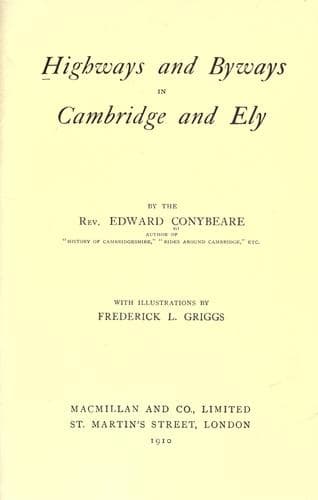
Highways and Byways in Cambridge and ElyConybeare, John William Edward
History
Highways and Byways in Cambridge and Ely
Conybeare, John William Edward
Cambridgeshire (England) -- Description and travel; Isle of Ely (England) -- Description and travel
"Though the Corporation of Cambridge has the tolls of this Fair,
and the government as aforesaid, yet the body of the University
has the oversight of the weights and measures thereof (as well as
at Midsummer and Reach Fairs) and the licensing of all
show-booths, live creatures, etc.; and the Proctors of the
University keep a Court there also to hear complaints about
weights and measures, seek out and punish lewd women, and see
that their Gownsmen commit no disorders."
Fuller (in the seventeenth century) gives us the tradition that the
fair originated with some Westmorland cloth dealers, who were here
overtaken by a storm on their way to Norwich, and found so ready a
market for the goods which they spread out to dry on the grass of the
common that they went no further but returned hither the next year,
and again. Thus the special prominence given to the "Duddery" here is
accounted for. The tradition does not seem improbable, for Kendal has,
from time immemorial, been renowned for its cloth--the famous "Kendal
green" worn, in old ballads, by the English archers. To this day the
shield of that town bears cloth-making implements, with the motto
"_Pannus mihi panis_" ("Flock is my food"). And Norwich was
(throughout the Middle Ages) the great commercial centre of the cloth
trade. That there was some marked connection between Cambridgeshire
and Westmorland is proved by the constant occurrence here of family
names derived from Kendal place-names (Sizergh, Docwray, Strickland,
Sedgwick, etc.) which have been current amongst the peasantry of
Cambridgeshire since the fourteenth century at least.
Since Carter wrote, the great development of communication has made
fairs a mere survival, and Stourbridge Fair has fallen from its high
estate. It is now a very commonplace affair of a few days' duration,
mainly for the horse trade. But it still is declared open by the Mayor
of Cambridge or his delegate, and a dish of the white herrings which
Carter speaks of still forms part of the opening ceremony. And it has
an abiding interest for English readers, as the prototype of "Vanity
Fair" in the "Pilgrim's Progress." Bunyan, as a Bedford man, would be
familiar with the bustling scene, and, if we compare his pages with
those which we have transcribed from Carter's History, we see how
vividly he has allegorised it:
"At this Fair are all such Merchandize sold as Houses, Lands,
Trades, Places, Honours, Preferments, Titles, Countreys,
Kingdoms, Lusts, Pleasures, and Delights of all sorts, as Whores,
Bauds, Wives, Husbands, Children, Masters, Servants, Lives,
Blood, Bodies, Souls, Silver, Gold, Pearls, Precious Stones, and
what not.
"And moreover at this Fair there is at all times to be seen
Juglings, Cheats, Games, Plays, Fools, Apes, Knaves, and Rogues,
and that of every kind.
Public-domain text, read in full here on John Shaqi.
Reviews
Reviews
No reviews yet
Be the first to share your thoughts on this work.
Elsewhere in the archive
Join the Discussion
Join the discussion
Sign in to leave a comment or review.
Sign InorCreate an account