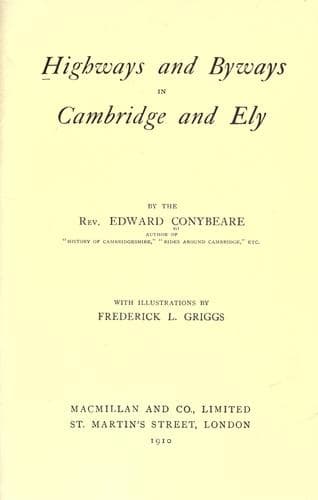
Highways and Byways in Cambridge and ElyConybeare, John William Edward
History
Highways and Byways in Cambridge and Ely
Conybeare, John William Edward
Cambridgeshire (England) -- Description and travel; Isle of Ely (England) -- Description and travel
And as the river divides, so also does our London Road, one route
following either valley. The Granta route goes via Bishop Stortford
and Epping Forest, entering London by the Mile End Road, the other via
Royston, Ware, and Tottenham, coming in by Bishopsgate Street. The
division comes just as we leave Trumpington, at the lych-gate of the
village cemetery, whence the left-hand branch brings us to the twin
villages of Great and Little Shelford, with the Granta running between
them. Both churches are good, the former with an octagonal steeple,
and a churchyard kept like a garden, and the latter with a grand
square-headed Decorated window in its transept, where are preserved
some nice fragments of the ancient alabaster reredos. There are also
various good fifteenth century monuments of the De Freville family,
whose name still lives on as that of a suburban district in Cambridge.
Great Shelford Church is richly decorated, as it seems to have been of
old, for here Dowsing destroyed no fewer than 128 "superstitions." The
bridge over the Granta between the two villages was in mediaeval times
under the charge of a hermit, like Newnham Bridge at Cambridge.[167]
[Footnote 167: See p. 41.]
[Illustration: _Great Shelford Church._]
Villages continue to be found on both banks as we ascend the Granta.
The main road, on the east of the stream, leads through Stapleford, a
small place, to the large and important Sawston. Its size and
importance are due to the existence of that all too rare development,
a really thriving rural industry. For here is not only a flourishing
paper-mill, turning out its twenty tons a week of superfine
copper-glazed paper, but the much more uncommon manufacture of
parchment, and of the "shammy" leather used for cleaning plate, etc.
And this is produced in a delightfully rural and old-time fashion.
There are no machines here automatically grinding out facsimile
products; every process is confided to the skill and judgment of the
individual in charge of it. There are fifteen or sixteen such
processes involved, and a very little carelessness in any one of them
would spoil the whole series. Thus every workman is an expert, and
takes a pride in his work impossible to the mere driver of a machine.
The great aim of each is to "keep his skin in condition" while under
his hands, so as to have a right to glory in the finished article.
Public-domain text, read in full here on John Shaqi.
Reviews
Reviews
No reviews yet
Be the first to share your thoughts on this work.
Elsewhere in the archive
Join the Discussion
Join the discussion
Sign in to leave a comment or review.
Sign InorCreate an account