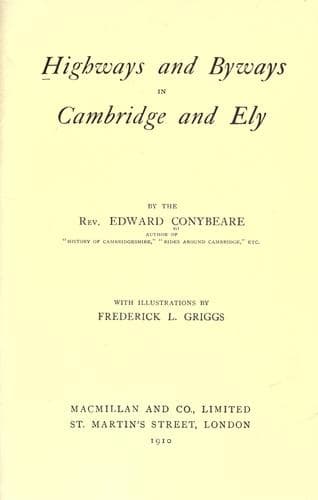
Highways and Byways in Cambridge and ElyConybeare, John William Edward
History
Highways and Byways in Cambridge and Ely
Conybeare, John William Edward
Cambridgeshire (England) -- Description and travel; Isle of Ely (England) -- Description and travel
Sawston, moreover, is not only full of present interest, but rich in
associations with the past. The Village Cross stands on its ancient
site, and the church, which retains some Norman features, has several
mediaeval brasses, though none of special merit. The Hall is yet more
remarkable. It was built in the reign of Queen Mary with materials
from the ruins of Cambridge Castle, granted by her in consideration of
the earlier hall having been destroyed for sheltering her. At the
death of her brother Edward the Sixth, the Protestant Lords of the
Council sought to arrest her as she approached London. Hearing of
their design she took refuge at Sawston Hall, then as now the seat of
the Huddleston family, who then as now steadfastly adhered to the
ancient faith. Her presence there being reported at Cambridge, a
Protestant mob, under the direction of the authorities, pounced upon
the hall so suddenly that she had barely time to escape on horseback
behind one of the serving men, her course lighted by the flames of the
burning building, which was utterly destroyed by the disappointed
Protestants. A missal taken in the sack was, on the following Sunday,
held up to public derision and formally torn to pieces in the
University Church.
By the time the rebuilding of the hall was completed another, and more
thoroughgoing, Protestant persecution had broken out. To hear Mass was
made treason-felony, punished by forfeiture of goods and perpetual
imprisonment, while to say it was an act of high treason, for which
the offending priest suffered the lingering death assigned by the law
to traitors, being first half-hanged, then disembowelled, and finally
quartered. The Catholic chapels of the day were accordingly placed in
the garrets, as in that still existing at Sawston Hall, where the
worshippers had most warning in case of a domiciliary visit by the
authorities. Secret cupboards were contrived for hiding the sacred
vessels, books, and vestments, and secret exits by which the priest
might, if possible, be smuggled out of the house, and, in case these
proved unavailable, "Hiding Holes" in which he might take refuge. That
at Sawston Hall is in the staircase, and is described by Mr. Allan Fea
in his _Secret Chambers and Hiding Places_:
Public-domain text, read in full here on John Shaqi.
Reviews
Reviews
No reviews yet
Be the first to share your thoughts on this work.
Elsewhere in the archive
Join the Discussion
Join the discussion
Sign in to leave a comment or review.
Sign InorCreate an account