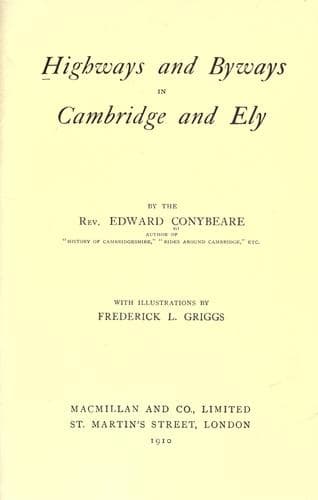
Highways and Byways in Cambridge and ElyConybeare, John William Edward
History
Highways and Byways in Cambridge and Ely
Conybeare, John William Edward
Cambridgeshire (England) -- Description and travel; Isle of Ely (England) -- Description and travel
Another such tributary rises in our next village, Melbourn, and runs,
on its way to the Cam, through the adjoining Meldreth, an old-world
place, where the parish stocks are still to be seen at the village
cross-roads. Till the nineteenth century was well on its way, these
instruments of punishment were in actual use for the correction of
minor offences such as vagrancy. They consist of a low upright frame
of rough wood, so contrived that the prisoner's feet, as he sat upon
the ground beside it, were passed through holes in the structure and
there secured. The parish constable was supposed to keep sentry over
him, but actually seldom kept off either the friends, who might
alleviate his captivity by beer and tobacco, or the more numerous
enemies, who found it a good joke to tease and pelt his helplessness.
The hands were sometimes also secured, sometimes not; but in any case
the culprit's situation was exceedingly unpleasant, and the stocks
proved a most wholesome deterrent.
[Illustration: _Shepreth._]
Melbourn is a larger place, and boasts that rare possession, a village
trysting-tree. This is a huge elm, standing by the roadside at the
churchyard gate. It is now at the extremity of elm life, some three
hundred years old, and only the stump (still clothed with leafage)
remains. But the vast massiveness of the roots show its former
grandeur. At this tree, in 1640, the villagers spontaneously gathered
to resist the imposition of the "ship-money," whereby Charles the
First was striving to recruit his exhausted exchequer. "And they fell
upon the sheriff's men with stones and staves, and hedgestakes and
forks, and beat them and wounded divers of them, and did drive them
out of the highway into a woman's yard for their safety. And were
forced for saving of their lives to get out of the town a back way;
which, notwithstanding, some thirty or forty able men and boys pursued
them above a quarter of a mile, stoning them, and driving the bailiffs
into a ditch, where some of their horses stuck fast. And the multitude
got some of the bailiffs' horses and carried them away, and would not
redeem them without money."
This stirring episode shows that the men of Melbourn were already
Puritan stalwarts, a character which the place has ever since
maintained. Three years later the parson himself removed from the
church "sixty superstitious pictures," and a cross from the steeple,
and digged down the altar steps. And after the Restoration, when
Nonconformity was put under the straitest ban of the law, its worship
still continued here to be practised, so that the place became, as it
still remains, the chief centre of the Free Church form of religion in
this part of the county.
Public-domain text, read in full here on John Shaqi.
Reviews
Reviews
No reviews yet
Be the first to share your thoughts on this work.
Elsewhere in the archive
Join the Discussion
Join the discussion
Sign in to leave a comment or review.
Sign InorCreate an account