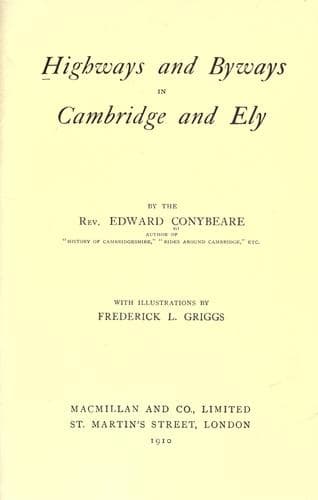
Highways and Byways in Cambridge and ElyConybeare, John William Edward
History
Highways and Byways in Cambridge and Ely
Conybeare, John William Edward
Cambridgeshire (England) -- Description and travel; Isle of Ely (England) -- Description and travel
The result, after a while, was, as we have seen, a great increase in
prosperity, testified to by the abundant Perpendicular work in almost
every parish church in England. But the immediate effect was fearful
distress, and a chaotic dislocation of the old feudal relationships,
giving birth to the socialistic dreams which for a moment so vainly
tried to materialise themselves in the anarchical outbreak which we
call Wat Tyler's Rebellion. An example of this dislocation of ordinary
conditions is furnished by the Papal registers, which tell us that the
rectory of this very Bassingbourn (estimated at the equivalent of no
less than L1,200 per year) was made over, in 1410, to the Chapel Royal
of St. Martin's-le-Grand, London, "considering that the said chapel
hath been ruined by the Great Storm, and its lands lie waste for lack
of labourers through the pestilence."
The "great storm" here referred to took place on St. Maur's Day
(January 15th), 1361. Of both storm and pestilence we shall find a
most interesting record in the church of Ashwell, the next and last
place which we should see in this corner of the county. To reach it we
have, indeed, to cross the border and go some half mile beyond; but
though politically in Hertfordshire, Ashwell physically belongs to
Cambridgeshire. For here is the source of the Cam, and such a source
as few would dream of for the sluggish unclear stream that we see at
Cambridge. In the midst of the village the ground sinks into a sort of
amphitheatre, some 100 yards in length by thirty in breadth and ten in
depth, with abrupt sides covered with brushwood and overshadowed by
ancestral ash-trees. All round the floor of this gush forth springs
upon springs of the brightest, most sparkling water; so copious that
when the infant stream escapes through a breach towards the north it
is already nearly thirty feet broad. No prettier river-source is to be
found throughout the length and breadth of England. The ash-trees,
however, are not, as one is apt to think at first, the origin of the
name, but its consequence. The first syllable really embodies that
Celtic word for water which, as Axe, Exe, Esk, and Usk, meets us in so
many places all over Great Britain; and this syllable, at some
far-back date, suggested the planting of ashes around the well.
[Illustration: _Ashwell._]
Not far from these bounteous springs rises the splendid tower of the
church, springing high into the air with the same undaunted Early
English ambition which raised the spire of Salisbury. And on its wall
(inside) is carved, in rude and deeply incised lettering of Old
English style, varied by some curiously Greek characteristics, the
record already spoken of, dealing with the Black Death and the storm.
This consists of four lines, intended for Latin elegiacs, again with a
Greek touch, and runs thus:
Public-domain text, read in full here on John Shaqi.
Reviews
Reviews
No reviews yet
Be the first to share your thoughts on this work.
Elsewhere in the archive
Join the Discussion
Join the discussion
Sign in to leave a comment or review.
Sign InorCreate an account