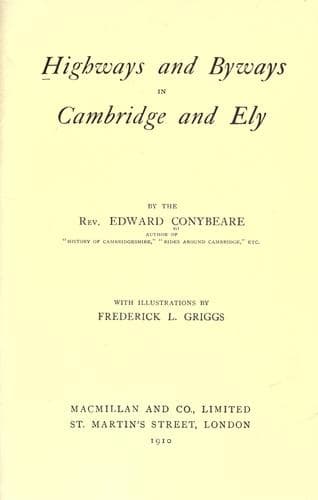
Highways and Byways in Cambridge and ElyConybeare, John William Edward
History
Highways and Byways in Cambridge and Ely
Conybeare, John William Edward
Cambridgeshire (England) -- Description and travel; Isle of Ely (England) -- Description and travel
Following the road to Long Stanton station (six and a half miles), we
there cross the G. E. R. (St. Ives Branch) and proceed, along a
somewhat dreary stretch, to Willingham (nine miles), where an
exceptionally fine church (All Saints) rewards our toil. After
lingering in neglect and decay for years beyond the neighbouring
churches, it has now become an ideal example of judicious restoration,
very different from the drastic process too often known by that name.
Every ancient feature and development has been preserved, including
the beautiful roof,[196] with its elaborate carving, its tiers of
angels and its double hammer beams, the fine parclose screens, and the
Perpendicular pulpit. Beneath the clerestory may be seen traces of no
fewer than four successive layers of frescoes, which, from the twelfth
to the seventeenth century, each in turn adorned the walls. But the
most striking feature of the church is the small Decorated "treasury"
adjoining the north wall of the chancel. It is wholly of stone, even
to the roof with its richly wrought "beams"; an almost unique example
of this method of treatment. Dowsing here destroyed, on 16 March,
1643, "forty superstitious pictures, a crucifix, and two superstitious
inscriptions, also two pictures of the Holy Ghost and one of the
Virgin Mary in brass."
[Footnote 196: This roof is traditionally said to have been that of
the great church of Barnwell Abbey (see p. 160). It obviously was made
for a larger nave than that of Willingham, and has been cut down to
fit its present purpose.]
From Willingham a field road will take us, if desired, to Belsar's
Hill,[197] which, besides its historical associations, is rich in the
pretty crystals of selenite or gypsum. And though, as has been said,
the track is now all but disused, it is still possible to follow the
Conqueror's causeway to the Ouse and get ferried over to Aldreth.
[Footnote 197: See p. 283.]
* * * * *
The next turn on the Via Devana is the southward lane to Madingley,
already described. Southward also lie Lolworth, Boxworth and Elsworth.
The last has an exceptionally fine church, Decorated throughout, and
displaying the almost unique feature of small lockers for books in the
fourteenth century stalls. Conington, near the road on the same side,
has a stone-ribbed spire containing three mediaeval bells--a rare
survival. They bear the following inscriptions:
1. ASSVMPTA . EST . MARIA . IN . CELIS . GAVDENT . ANGELI
LAVDANTES . BENEDICVNT . DOMINVM.
Mary is taken up to Heaven. The Angels are glad.
They praise and bless the Lord.
2. SANCTA . MARIA . ORA . PRO . NOBIS
Holy Mary pray for us.
3. VIRGO . CORONATA . DVC . NOS . AD . REGNA . BEATA .
O crowned Maid lead us to realms of bliss.
[Illustration: _Over, South Porch._]
Public-domain text, read in full here on John Shaqi.
Reviews
Reviews
No reviews yet
Be the first to share your thoughts on this work.
Elsewhere in the archive
Join the Discussion
Join the discussion
Sign in to leave a comment or review.
Sign InorCreate an account