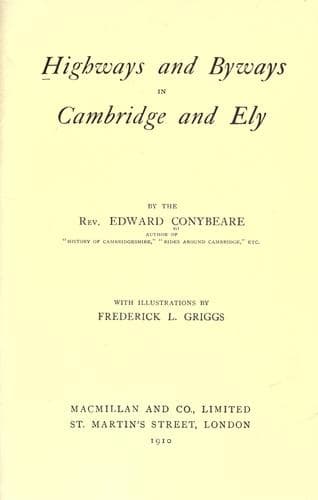
Highways and Byways in Cambridge and ElyConybeare, John William Edward
History
Highways and Byways in Cambridge and Ely
Conybeare, John William Edward
Cambridgeshire (England) -- Description and travel; Isle of Ely (England) -- Description and travel
Such was the daring message that, according to Matthew Paris, issued,
in the year 1267, from the Fenland stronghold. The Bishop and the men
of Lynn had failed to daunt the recusants, and now the Legate had met
with no better success. The following year came the King in person,
along with his valiant son Edward "Longshanks," to try what the Strong
Hand could do; and besieged the island. We can imagine how the father
and son, as they sighted Ely, must have felt the contrast between
their approach this time and their arrival fifteen years before. Then
all was peace and welcome, now it is bitter war. They had Scottish
troops at their command, and by constructing bridges of hurdles and
planks they forced an entrance to the island; and soon the insurgents
had no choice but to yield; some surrendered, while the rest took to
flight. Their cause seemed lost; but in truth it was destined to
triumph, for when Edward the First, six years later, returned as King
from his Crusade, he granted all, and more than all, that the Barons
had asked for, by calling into being England's first representative
Parliament.
Throughout the course of these wars and tumults the House of God at
Ely stood uninjured in beauty and security. But about the opening of
the fourteenth century there appeared cracks in the great Central
Tower. These massive Norman towers were not so strong as they looked,
their piers being not, as they appeared to be, of solid stone, but
only hollow pipes filled in with rubble. It was known that a similar
tower at Winchester had fallen; the same disaster now threatened Ely;
the monks were warned against entering the Abbey Church, and were
bidden to say their office in an ancient chapel adjoining the Chapter
House.
The catastrophe long foreseen came to pass on February 22, 1322. Late
in the evening, as the monks were retiring to their dormitories, "with
such a shock," says the chronicler, "that it was thought an earthquake
had taken place," the tower fell toward the east, crushing the walls
and pillars of the Norman choir. Northwold's presbytery further east
remained unhurt, nor did the shrine of St. Etheldreda behind the high
altar receive any damage. The nave and transepts likewise escaped
injury. No one was killed, for in consequence of the timely warning
the church was deserted.
Providentially the monk at this time in charge of the Cathedral fabric
was an architect of rare genius, the most gifted, probably, that
England has ever produced. For the Sacrist when this calamity befell
was none other than the famous Alan of Walsingham, who was called by
his contemporaries "the flower of craftsmen," and he it was who, in
virtue of his office, was responsible for repairs. In the full vigour
of life, a man of twenty-eight, who had been trained as a goldsmith,
he rose to the occasion, and proved well able to cope with the problem
and task before him.
Public-domain text, read in full here on John Shaqi.
Reviews
Reviews
No reviews yet
Be the first to share your thoughts on this work.
Elsewhere in the archive
Join the Discussion
Join the discussion
Sign in to leave a comment or review.
Sign InorCreate an account