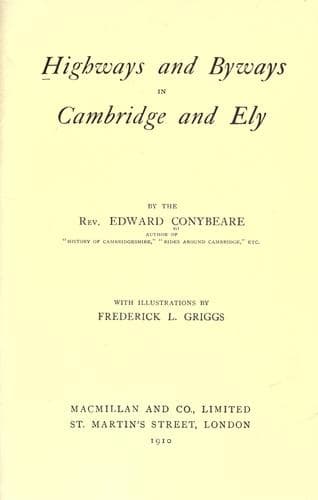
Highways and Byways in Cambridge and ElyConybeare, John William Edward
History
Highways and Byways in Cambridge and Ely
Conybeare, John William Edward
Cambridgeshire (England) -- Description and travel; Isle of Ely (England) -- Description and travel
We return to the Tower, and pause for a moment to notice "the
Maze"[224] inlaid in marble in the pavement. From this quaint design
at our feet we turn to look at the roof of the nave over our heads,
painted with scenes from the Old and New Testaments. The western end
is the work of Mr. Le Strange, who died in 1864, before his work of
love was completed. Happily it was continued and finished by Mr.
Gambier Parry, as devoted a lover of the Church and of art, a personal
friend of Harvey Goodwin, who was Dean at the time, and at whose
request the artist undertook the arduous task of roof-painting. A
slight change in the character of the designs shows where one painter
ended his work and the other took it up.
[Footnote 224: This is a wholly modern device. Mediaeval mazes are
common in Continental churches; but none are found in England.]
These over-head paintings take us from the Creation of Man and his
fall, through the old Testament up to the Annunciation and Nativity,
in a series of scenes instructively thought out; while Patriarchs and
Prophets lead on to the Evangelists. Some part of the design is said
to be due to a visit paid by Mr. Le Strange, on the advice of Sir
Gilbert Scott, to the Church of Hildesheim in Hanover, where there
existed a then untouched painted ceiling of mediaeval date; but in the
main it was his own conception.
Let us next turn aside into the southern aisle to look at the "Prior's
Door." If we find it locked we can get it opened by asking one of the
vergers to let us go through it. We shall thus obtain a sight of its
outer mouldings; bold and fantastic, yet withal dignified and
graceful, executed about the year 1180, and due, it may be, to some
Masonic Company that had handed on its traditions from east to west,
generation after generation; perhaps to members of that "Comacine
Guild" that had its headquarters on an island in Lake Como, where its
members had taken refuge from the Gothic invaders of Italy. In the
tympanum, within a vesica shaped panel, is sculptured our Lord in
Glory, holding in His left hand a book and a cross, while the right is
raised in the act of blessing. On the door-posts are carved designs
somewhat grotesque, suggesting the Signs of the Zodiac, and the course
of human life.
Public-domain text, read in full here on John Shaqi.
Reviews
Reviews
No reviews yet
Be the first to share your thoughts on this work.
Elsewhere in the archive
Join the Discussion
Join the discussion
Sign in to leave a comment or review.
Sign InorCreate an account