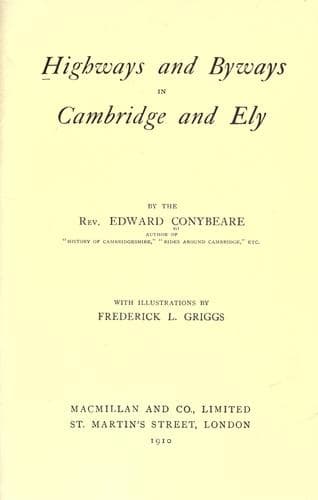
Highways and Byways in Cambridge and ElyConybeare, John William Edward
History
Highways and Byways in Cambridge and Ely
Conybeare, John William Edward
Cambridgeshire (England) -- Description and travel; Isle of Ely (England) -- Description and travel
The monuments within the Ambulatory may now claim our attention.
Starting at the southern entrance, let us look first at a canopy of
coloured stone, the tomb of De Luda, Bishop of Ely from 1290 to 1298.
The builder of Ely Chapel,[226] Holborn, he was eminent for learning,
and was keen to enrich the See; as a man of note he was sent by Edward
the First to France to settle terms of peace. Here we can study the
details of Decorated work at its best. Close at hand is Bishop
Barnett's tomb of grey marble, of a date somewhat later, robbed of the
effigy in brass which was once part of it. Next we come to the
cenotaph of Tiptoft, Earl of Worcester, who lived during the Wars of
the Roses. He had travelled to Jerusalem, and had made his home in
Italy, and was known as "The Pilgrim Scholar." A pioneer of Greek,
then reviving in the schools of Western Europe as the result of the
fall of Constantinople, he was also a patron of Caxton and his novel
printing press. Under Edward the Fourth he tried his hand at governing
Ireland, where his cruelty toward the Lancastrians gained for him the
name of "the Butcher." He was beheaded in 1470, and appears here in
marble lying between his two wives. Next note Bishop Hotham's tomb, of
the Decorated period. His name is familiar to us as having promoted by
every means in his power the work carried out by Alan of Walsingham.
[Footnote 226: See p. 322.]
So far the tombs we have noticed have stood in a line under three
arches of the Presbytery, as the eastern part of the Choir is called:
we now turn to the south aisle to look at that of Peter Gunning,
Bishop of Ely under Charles the Second, who wrote (as we mentioned
before) the prayer to which we owe the phrase "All sorts and
conditions of men." The mitred bishop rests his head on one hand, in
an attitude somewhat ungainly, and his monument is of little artistic
merit. But the resolute, delicately-cut features deserve our study,
and the epitaph is of interest as recording how he had vindicated the
Church of England in the presence of Cromwell himself. Let us pause a
few steps further east to look at the calm face of Canon Selwyn, a
nineteenth century lover of the cathedral; and then, as we pass the
tomb of Bishop Eustace, who built the western porch, let us go back in
thought to the far-off troublous days of King John.
From the Retro-choir we enter Bishop West's chapel, rich with the
ornament of Perpendicular architecture at its highest pitch of
elaboration. Nicholas West was Bishop of Ely under Henry the Eighth,
from 1515 to 1533; and little did he foresee that the sanctuary he was
adorning with the devotion of a lover who offers of his best would be
despoiled and defaced by his own immediate successor in the See.
Public-domain text, read in full here on John Shaqi.
Reviews
Reviews
No reviews yet
Be the first to share your thoughts on this work.
Elsewhere in the archive
Join the Discussion
Join the discussion
Sign in to leave a comment or review.
Sign InorCreate an account