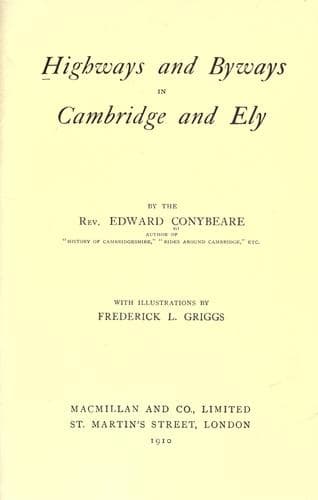
Highways and Byways in Cambridge and ElyConybeare, John William Edward
History
Highways and Byways in Cambridge and Ely
Conybeare, John William Edward
Cambridgeshire (England) -- Description and travel; Isle of Ely (England) -- Description and travel
Here, too, lie the bones of the great Earl Brithnoth, who, as we
remember, was brought back hither headless, from the battle of Maldon,
by the monks of Ely to be buried amongst them according to their
promise. We connect this warrior's character with the dying words
attributed to him in Anglo-Saxon poetry, "God, I thank Thee for all
the joy that I have had of Thee in life."[227] Other Anglo-Saxon
worthies of the ninth and tenth centuries rest also in this chapel: an
Archbishop of York, a Swedish Bishop, and several Bishops of Elmham,
in Suffolk, and Dorchester, in Oxfordshire--Sees which were in later
years transferred to Norwich and Lincoln respectively. It is held that
these were retired prelates, who had come to end their days at Ely;
where they were welcome guests, as they were licensed by the Diocesan
to perform the often-needed episcopal functions of the Abbey, without
calling in the distant and over-busied Bishop of Dorchester, to whose
See Ely belonged. This was a convenience both to the Brotherhood and
to the Diocesan himself. The names of Earl Brithnoth and of these
contemporaries are inscribed on tablets let into the wall of this
chantry.
[Footnote 227: See p. 312]
Touching it on the northern side, behind the screen of the High Altar,
we see a fine tomb, Perpendicular in style, where lies buried the
Cardinal de Luxembourg, a foreign prelate presented to the See of Ely
in 1438 by King Henry the Sixth, but never (it seems) canonically
confirmed as Bishop. In order to gain space for his chapel, Bishop
West did not scruple to take a slice off the tabernacled work of
unrivalled beauty that adorned this adjoining tomb, but the northern
side he left in its perfection. Notice, too, close at hand, a bronze
monument to Dr. Mills, professor of Hebrew, who died about the middle
of the nineteenth century. The recumbent figure is of great beauty.
Next we come to Bishop Alcock's chapel, occupying the northern corner
of the ambulatory, as Bishop West's does the southern. It was built, a
generation earlier, by Bishop Alcock only a few years after his
reconstitution of St. Radegund's Priory at Cambridge as Jesus College,
recorded in our sixth chapter, and is marked as his by the frequent
recurrence of his "canting" armorial bearings, a shield and crest _all
cocks_, or, rather, black cocks' heads. He was a great builder, a
great worker, and, like many another ecclesiastic of his day, a great
politician, being Lord President of Wales, and Comptroller of the
Royal Works to Henry the Seventh; yet withal he was a man of marked
sanctity. His chapel is rich in Perpendicular ornament. A wreath of
grapes and vine-leaves in stone runs round it in all directions, as if
verily clambering. The undercutting of this wreath is wondrous, but
perhaps the marvel of it culminates in a pendant boss of vine-leaves
on the northern side so deeply wrought that we can see right through
it, yet perfect to-day as when first carved.
Public-domain text, read in full here on John Shaqi.
Reviews
Reviews
No reviews yet
Be the first to share your thoughts on this work.
Elsewhere in the archive
Join the Discussion
Join the discussion
Sign in to leave a comment or review.
Sign InorCreate an account