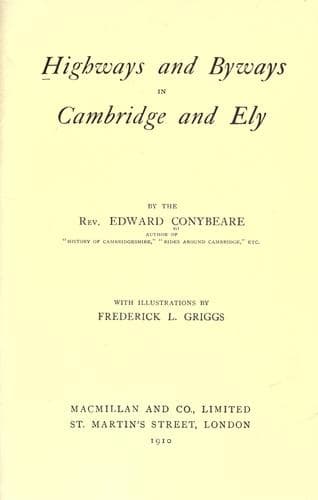
Highways and Byways in Cambridge and ElyConybeare, John William Edward
History
Highways and Byways in Cambridge and Ely
Conybeare, John William Edward
Cambridgeshire (England) -- Description and travel; Isle of Ely (England) -- Description and travel
give the "Minor" Orders (_i.e._ those beneath the grade of Deacon).
[Footnote 237: The history of the Houses outside our county we only
touch upon where connected with spots inside.]
Thorney was of earlier date; coeval, indeed, with Peterborough. Of its
foundation a graphic description is given by the chronicler. After
telling how King Wulfhere of Mercia (whose wife was sister to St.
Etheldreda), endowed Peterborough and its abbot Sexwulf with broad
possessions, he continues:
"Then said the King: 'This gift is little, but it is my will they
hold it so royally and so freely that neither geld nor fee be
taken from it....And thus free will I make this Minster, that it
be under Rome alone: and my will it is that all we who may not go
to Rome visit St. Peter here.'
"While thus he spake, the Abbot prayed of him that he would give
him whatsoever he should ask. And the King granted him. Then said
the Abbot: 'Here have I God-fearing monks, who would fain live as
anchorites (_i.e._, hermits), knew they but where. And here is an
island which is called Ancarig[238] (Thorney). And my boon is
that we might there build a Minster, to the glory of St. Mary, so
that they who would lead the life of peace and rest may dwell
therein.'
"Then the King answered and said: 'Beloved Sexwulf, lo! not only
that which thou hast asked, but all else on our Lord's behalf I
thus approve and grant.' ... And King Wulfhere first confirmed it
by word, and after subscribed it with his fingers on the Cross
of Christ" (_i.e._ he signed his name with a cross, on which he
laid his finger, saying, "I deliver this as my act and deed," as
we do with the seal on a deed at present. Seals did not come in
till the Norman Conquest). Amongst the witnesses to his signature
we find "Wilfrid the Priest, who was afterwards Bishop," _i.e._
the great St. Wilfrid of Ripon.
[Footnote 238: This name has probably nothing to do with "anchorite,"
but is of Celtic derivation.]
Thorney, however, was long in rising to abbatial dignity, and remained
the abode of anchorites, so humble and so sequestered that in the
great Danish raid of 870, when Ely and every other Religious House
throughout the Fenland was destroyed, the plunderers did not take the
trouble to seek it out, and it became a haven of refuge for the
survivors of the sack of Crowland. The story is graphically told in
the "Chronicle of Crowland"; in its present form probably a thirteenth
century work, but obviously compiled from earlier sources.
After describing vividly the utter overthrow, at a great battle in
Kesteven (West Lincolnshire), of the local forces hastily called out
to meet the Danish host, he tells how a few poor fugitives got them to
the Church of Crowland, and interrupted the Midnight Service with
their crushing tidings.
Public-domain text, read in full here on John Shaqi.
Reviews
Reviews
No reviews yet
Be the first to share your thoughts on this work.
Elsewhere in the archive
Join the Discussion
Join the discussion
Sign in to leave a comment or review.
Sign InorCreate an account