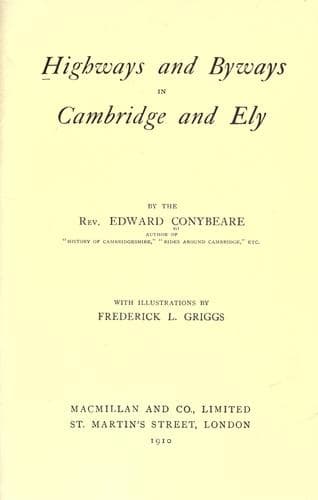
Highways and Byways in Cambridge and ElyConybeare, John William Edward
History
Highways and Byways in Cambridge and Ely
Conybeare, John William Edward
Cambridgeshire (England) -- Description and travel; Isle of Ely (England) -- Description and travel
The Abbot of Thorney was also "mitred," and the House ranked as second
only to Ely in the county. William of Malmesbury (A.D. 1135) describes
it as "a little paradise, delightsome as heaven itself may be deemed,
fen-circled, yet rich in loftiest trees, where water-meadows delight
the eye with rich green, where streamlets glide unchecked through each
field. Scarce a spot of ground lies there waste; here are orchards,
there vineyards. Nature vies with culture, and what is unknown to the
one is produced by the other. And what of the glorious buildings,
whose very size it is a wonder that the ground can support amid such
marshes? A vast solitude is here the monks' lot, that they may the
more closely cling to things above. If a woman is there seen, she is
counted a monster, but strangers, if men, are greeted as angels
unawares. Yet there none speaketh, save for the moment; all is holy
silence.... Truly I may call that island a hostel of chastity, a
tavern of honesty, a gymnasium of divine philosophy. From its dense
thickets it is called Thorney."
At the draining of the Fens, in the seventeenth century, Thorney was
assigned to the Earls (now Dukes) of Bedford, who, during the
nineteenth century alone, have expended on their Thorney estates
nearly L2,000,000. Yet the Thorney property does not even pay its way.
The noble owners have, however, their reward in the genuine success
which has crowned the experiment from a philanthropic point of view.
Thanks to their efforts, Thorney is again, as in the old days of the
Benedictines, a smiling, well-wooded oasis amid the dreary Fenland;
where the welfare of the tenantry is, as of old, the chief object of
the landlord, and where, in consequence, pauperism, drunkenness, and
crime are alike practically unknown. The remains of the Abbey Church
are still used for parochial worship, but only 117 of its original 290
feet of length have survived Henry the Eighth's demolitions.
CHAPTER XIX
Draining of Fens.--Monastic Works, Morton's Leam.--Diversion of
Ouse.--Local Government, Jurats, Discontent.--Jacobean
polemics.--First Drainage Company.--Rising of Fen-men.--Second
Company, Huguenot Labourers.--Third Company, Earl of Bedford,
Vermuyden.--Old River.--Cromwell.--Fourth Company, Prisoner
Slaves, New River, Denver Sluice.--Later Developments.
Public-domain text, read in full here on John Shaqi.
Reviews
Reviews
No reviews yet
Be the first to share your thoughts on this work.
Elsewhere in the archive
Join the Discussion
Join the discussion
Sign in to leave a comment or review.
Sign InorCreate an account