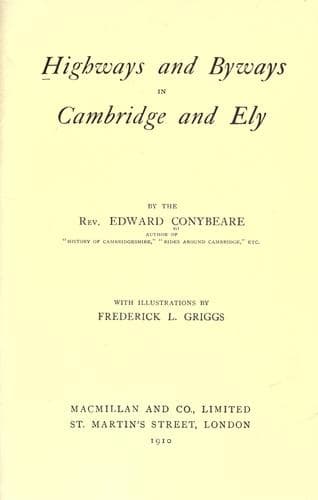
Highways and Byways in Cambridge and ElyConybeare, John William Edward
History
Highways and Byways in Cambridge and Ely
Conybeare, John William Edward
Cambridgeshire (England) -- Description and travel; Isle of Ely (England) -- Description and travel
That this had been the age-long course of the Fenland waters is shown
by the existence of a huge Roman sea wall running round the old coast
line from Lynn to Wisbech, and from Wisbech to Sutton in Lincolnshire.
This wall traces for us the outline of a great tidal estuary running
up to Wisbech, which continued an estuary even to the eighteenth
century. But the diversion of the greater part of its river water to
Lynn proved fatal to it. Such stream as was left, scarcely more than
that of the Nene, could not, at the ebb, scour out the channel through
the sands which the flood-tide continually tended to silt up. Wisbech
became more and more shut off from the sea, and is now ten miles away
from it. And further, the inability to escape quickly enough through
these choking sands drove the river water at Wisbech back upon itself
and forced it to "drown" the neighbouring fens; while at Lynn the same
disastrous effect was produced by the new volume of water being too
great for the narrow bed of the Little Ouse and flooding over the
banks all round. The Marshland, as the Norfolk district protected by
the Roman wall was called, suffered especially from this result of
interfering with Nature.
Nor did it prove possible to undo the mischief. When once a short cut
has been made for a great river, it is no easy matter to turn the
stream back into its old tortuous course; and, when once an estuary
has got thoroughly silted up, it is yet more difficult to restore it
to its old condition. Throughout the Middle Ages constant complaints
were made, and occasional attempts; but these were always brought to
nought by some conflicting interest or other which got the ear of the
Government. The fen problem was early recognised as a matter of
national concern, and, from the time of Edward the First onwards, the
Crown tried to grapple with it, but by hopelessly futile methods.
To begin with, the system of Local Government already established for
the regulation of Romney Marsh in Kent was extended to the Fenland.
The Sheriff was bound to summon twenty-four "jurats" from the
inhabitants of the neighbourhood, to deal with each difficulty as it
arose. But a plan which worked well enough for a district only some
ten miles by fifteen, and with no river to speak of, was wholly
inadequate to deal with the huge area and mighty forces of the
Fenland, even when this was divided (as it still is for drainage
purposes) into three "Levels," "North," "Middle," and "South." The
jurats hated their invidious office, and were themselves hated by the
inhabitants; each man always declaring that they had saddled him with
repairs which ought to have been laid upon some neighbour, and each
man ready to see his own land "drown" rather than put in a single
spadeful of work which, in his view, should have been someone else's
job.
Public-domain text, read in full here on John Shaqi.
Reviews
Reviews
No reviews yet
Be the first to share your thoughts on this work.
Elsewhere in the archive
Join the Discussion
Join the discussion
Sign in to leave a comment or review.
Sign InorCreate an account