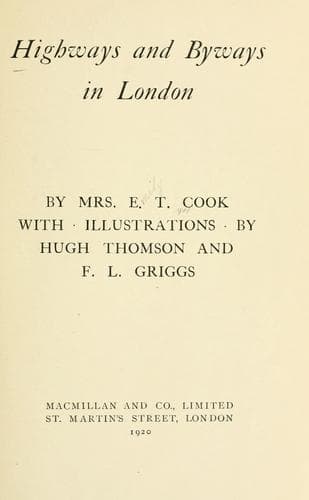
Highways and Byways in LondonCook, Emily Constance Baird
History
Highways and Byways in London
Cook, Emily Constance Baird
London (England) -- Description and travel
"The name of MR. VHOLES, preceded by the legend GROUND
FLOOR, is inscribed upon a doorpost in Symond's Inn,
Chancery Lane: a little, pale, wall-eyed, woebegone inn,
like a large dust-bin of two compartments and a sifter. It
looks as if Symond were a sparing man in his day, and
constructed his inn of old building materials, which took
kindly to the dry rot and to dirt and all things decaying
and dismal, and perpetuated Symond's memory with congenial
shabbiness. Quartered in this dingy hatchment commemorative
of Symond, are the legal bearings of Mr. Vholes.... Mr.
Vholes's office, in disposition retiring and in situation
retired, is squeezed up in a corner, and blinks at a dead
wall. Three feet of knotty-floored dark passage bring the
client to Mr. Vholes's jet-black door, in an angle
profoundly dark on the brightest midsummer morning, and
encumbered by a black bulkhead of cellarage staircase,
against which belated civilians generally strike their
brows. Mr. Vholes's chambers are on so small a scale, that
one clerk can open the door without getting off his stool;
while the other, who elbows him at the same desk, has equal
facilities for poking the fire. A smell as of unwholesome
sheep, blending with the smell of must and dust, is
referable to the nightly (and often daily) consumption of
mutton fat in candles, and to the fretting of parchment
forms and skins in greasy drawers. The atmosphere is
otherwise stale and close. The place was last painted or
whitewashed beyond the memory of man, and the two chimneys
smoke, and there is a loose outer surface of soot
everywhere, and the dull, cracked windows in their heavy
frames have but one piece of character in them, which is a
determination to be always dirty, and always shut, unless
coerced."
Indeed, the whole region of the law, in its by-ways, and smaller Inns,
is altogether suggestive of _Bleak House_. Dickens, a kind of Sam
Weller himself in his knowledge of London, knew all the Inns well,
living in several of them. He is a faithful chronicler, with this
reservation, that he has no eye for the picturesque interest, but is
all eye for the human. Were these places dirtier in Dickens's time?
That can hardly be. Why, one reflects, is there a kind of tradition in
such things? even as regards the eternal cats and the equally eternal
"laundresses"? (called so, presumably, because they never seem to
wash!) Why are the window panes, apparently, never, never, cleaned?
Has never any one come here with a love of cleanliness for its own
sake, or with a yearning for clean windows, to these Inns?
Public-domain text, read in full here on John Shaqi.
Reviews
Reviews
No reviews yet
Be the first to share your thoughts on this work.
Elsewhere in the archive
Join the Discussion
Join the discussion
Sign in to leave a comment or review.
Sign InorCreate an account