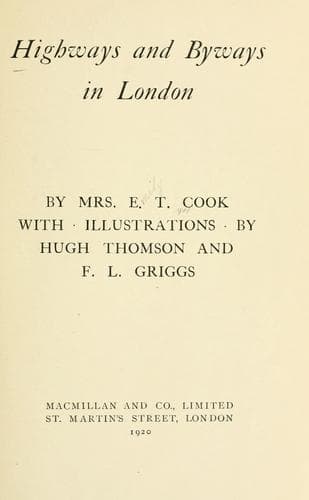
Highways and Byways in LondonCook, Emily Constance Baird
History
Highways and Byways in London
Cook, Emily Constance Baird
London (England) -- Description and travel
The neighbourhood in which the old Hall stands is full of historic
memories. As is ever the case in crowded Central London, the past, the
many pasts, are strangely involved and blended, buried one beneath the
other. Dryden and Otway are said to have once lived--and
quarrelled--on and near this site. Then, in 1710, Sir Isaac Newton,
the then President of the Royal Society, induced that body to buy a
house and garden here from Dr. Barebones, a descendant of the
"Praise-God-Barebones" of Puritan times. Sir Christopher Wren
concurred in the purchase, and £1,450 was paid for the freehold. In
this house the Royal Society held their meetings till they removed to
Somerset House in 1782; and they built on its garden the present
"Newton Hall,"--which hall, some say, is really from the designs of
Wren. In 1818, Samuel Taylor Coleridge, unhappy son of genius, gave
his last public lectures here; later, it was used as a chapel, and
then the Positivist Society made it their home. It is strange to
reflect that the chief reason advanced by Sir Isaac Newton to the
Royal Society for the purchase of this site, was that it was "in the
middle of the town and out of noise."
At the Holborn end of Fetter Lane there are still some fine old gabled
houses, which must soon vanish; several little Inns of Chancery,
byways out of Holborn and the Strand, have already been swept away:
Thavies' Inn for instance, where Dickens, surely by an intentional
anachronism, places Mrs. Jellyby's untidy home; Lyon's Inn, near Wych
Street, destroyed in 1863; Old Furnival's Inn, on the opposite side of
Holborn, where Dickens lived when he was first married, has been
replaced by the offices of the Prudential Assurance Company, the
saviours of Staple Inn, in intense red-brick. Lastly, Barnard's Inn
(originally Mackworth's Inn), a charming little Holborn Inn on a tiny
scale, with small courts, trees, a miniature hall and lanthorn, has
been bought up by the Mercers' Company and is used by them as a
school. This Inn is therefore not now accessible to the casual
visitor; its Holborn entrance may, indeed, easily be missed; "Mercers'
School," in big gilt letters, adorns its narrow doorway. What a
delightful private residence, one thinks, for some rich man, would
such a little Inn as this have made! Strange that no rich man has ever
thought so! the rich, like sheep, flock ever towards the less
interesting West End. Dickens, as I have suggested, had little eye for
the purely picturesque; and of this little Inn, compared by Loftie to
one of De Hooghe's pictures, he merely says (in _Great Expectations_,)
that it is "the dirtiest collection of shabby buildings ever squeezed
together in a rank corner as a club for tom-cats!" So much, indeed, is
Beauty in the eye of the seer! Barnard's Inn is also remarkable for
having been, in the last century, the abode of the last of the
alchemists.
Public-domain text, read in full here on John Shaqi.
Reviews
Reviews
No reviews yet
Be the first to share your thoughts on this work.
Elsewhere in the archive
Join the Discussion
Join the discussion
Sign in to leave a comment or review.
Sign InorCreate an account