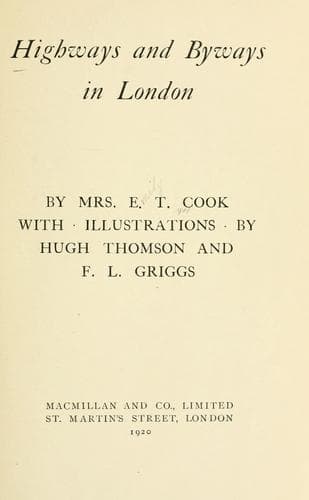
Highways and Byways in LondonCook, Emily Constance Baird
History
Highways and Byways in London
Cook, Emily Constance Baird
London (England) -- Description and travel
"London," says a French writer, "resembles, in its size and luxury,
Ancient Rome." But, if Ancient Rome, he adds, weighed heavily upon
its toiling slaves, "how heavily does not our modern Rome weigh,
also, upon the labouring class!" The hanging gardens of Park Lane
are in as great, and greater contrast to the Somers Town, Drury
Lane, and Deptford slums, as were ever the Palaces of the Palatine
to the slaves' quarters. London is the best city in the world to be
rich in, the worst to be very poor in; as it is the best city for
happiness, the worst for misery. It is the Temple of Midas, where
everything,--from a coffin to a hired guest,--from the _entrée_ to
an "exclusive" mansion to a peer's status,--can be bought with
money. Here, more than anywhere else, money is imperatively needed.
Even the poor hawkers who live in unspeakable slums, lined with cats
and cabbages, in Lisson Grove, might, if they lived in the country,
at least have clean cottages, gardens, and pure air. With the same
income on which you are poor in town, you will be well-to-do, nay,
rich in the country. House-rent,--indirect taxation,--the vicinity
of tempting shops,--and amusements take the surplus. The attractions
of town must indeed be great to the poor; for, if their wages be
higher, their life is infinitely lower. But it is the same in all
classes. It is often said that the rich, who own so many large and
luxurious country estates, houses, and gardens, are ill-advised to
come up to town and spend hot Mays and Junes in baking Belgravia or
Mayfair; but, after all, they only share the tastes of the majority.
Man is a gregarious animal, and loves his kind. Similarly, if you
were to make a "house-to-house visitation" in some wretched Lisson
Grove or East End slum, and inquire diligently of every inhabitant,
whether they would prefer to "go back and live in the lovely
country," their answer, I am convinced, would be firmly in the
negative. East and West are alike in this.
But the key-note of the East End of London, apart from its big
thoroughfares, is not so much squalor or poverty, as desperate,
commonplace monotony, such as is described by Mrs. Humphry Ward in
_Sir George Tressady_, "long lines of low houses,--two storeys always,
or two storeys and a basement,--all of the same yellowish brick, all
begrimed by the same smoke, every door-knocker of the same pattern,
every window-blind hung in the same way, and the same corner 'public'
on either side, flaming in the hazy distance." The East End is very
conservative, and in its better houses there is a conservatism even in
the blinds, which are, almost invariably, of cheap red rep or cloth,
alternated by dirty "lace." With the poorest tenants, of course,
blinds are at a discount; and grimy paper fills the frequent holes in
the panes.
Public-domain text, read in full here on John Shaqi.
Reviews
Reviews
No reviews yet
Be the first to share your thoughts on this work.
Elsewhere in the archive
Join the Discussion
Join the discussion
Sign in to leave a comment or review.
Sign InorCreate an account