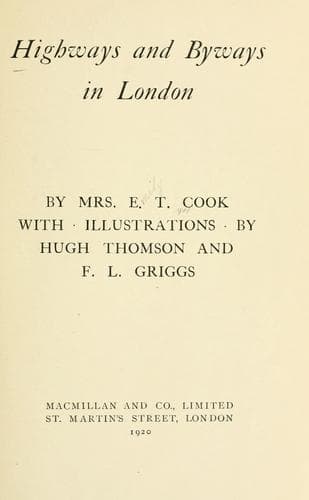
Highways and Byways in LondonCook, Emily Constance Baird
History
Highways and Byways in London
Cook, Emily Constance Baird
London (England) -- Description and travel
week,--and plaguey dear!"? But,--even considering the vast difference
in money value since Swift's day,--we have to pay a good deal more
than that now for similar accommodation in this quarter.
But, yet further West, between Bond Street and Hyde Park, are
Grosvenor and Berkeley Squares, the very focus of fashion, in whose
neighbourhood rents rise proportionately. Here, too, are many
unexpected and charming byways. Behind the vestry in Mount Street, for
instance, in the passage that leads into the church in Farm Street,
you might think yourself thousands of miles away from Mayfair. This
church in Farm Street,--the Roman Catholic Church of the Immaculate
Conception,--is famous as a Jesuit centre; here it was that Henry
Manning, afterwards Cardinal, was "received" on Passion Sunday, 1851.
Other byways there are, too, of a less attractive kind; the byways
where dwell the "poor relations," so to speak, of the Aristocracy and
the "Smart Set"; the impoverished ladies whose sense of propriety
would lead them to dwell even in a wheelbarrow, could that wheelbarrow
only be drawn up on the fashionable side of the street! They are
"backmewsy" little streets of saddening aspect, such as Dickens's
typical "Mews Street, Grosvenor Square," that contained the residence
of Mr. Tite Barnacle, with "squeezed houses," each with "a ramshackle
bowed front, little dingy windows, and a little dark area like a damp
waistcoat pocket" ... the house a sort of bottle filled with a strong
distillation of mews, so that when the footman opened the door, he
"seemed to take the stopper out." Dickens's picture is still a
portrait that many will recognise:
"Mews Street, Grosvenor Square, was not absolutely Grosvenor
Square itself, but it was very near it. It was a hideous
little street of dead wall, stables, and dunghills, with
lofts over coach-houses inhabited by coachmen's families,
who had a passion for drying clothes, and decorating their
window-sills with miniature turnpike-gates. The principal
chimney-sweep of that fashionable quarter lived at the blind
end of Mews Street; and the same corner contained an
establishment much frequented about early morning and
twilight, for the purchase of wine-bottles and
kitchen-stuff. Punch's shows used to lean against the dead
wall in Mews Street, while their proprietors were dining
elsewhere; and the dogs of the neighbourhood made
appointments to meet in the same locality. Yet there were
two or three small airless houses at the entrance end of
Mews Street, which went at enormous rents on account of
their being abject hangers-on to a fashionable situation;
and whenever one of these fearful little coops was to be let
(which seldom happened, for they were in great request), the
house agent advertised it as a gentlemanly residence in the
most aristocratic part of town, inhabited solely by the
élite of the _beau monde_."
Public-domain text, read in full here on John Shaqi.
Reviews
Reviews
No reviews yet
Be the first to share your thoughts on this work.
Elsewhere in the archive
Join the Discussion
Join the discussion
Sign in to leave a comment or review.
Sign InorCreate an account