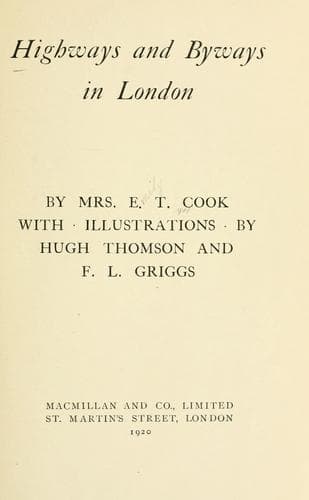
Highways and Byways in LondonCook, Emily Constance Baird
History
Highways and Byways in London
Cook, Emily Constance Baird
London (England) -- Description and travel
"Westminster Abbey," said Dean Stanley, "stands alone amongst the
buildings of the world. There are, it may be, some which surpass it in
beauty or grandeur; there are others, certainly, which surpass it in
depth and sublimity of association; but there is none which has been
entwined by so many continuous threads with the history of a whole
nation."
The old Abbey of Westminster, is, indeed, in itself an epitome of
English history. Elsewhere in London, you must dig and delve for it,
study and reconstruct; here, you have it all together, a chain in a
manner unbroken, from Edward the Confessor to the latest of our
Hanoverian Kings, crowned here, so lately and so splendidly, in the
place of his fathers.
The church has, in a manner, been founded many times; by tradition, by
rebuilding, by frequent restoration and enlargement. The earliest
church, or temple, on this ancient site is, indeed, almost lost in the
semi-fabulous mists of early history. To all famous fanes, the
after-years have a tendency to ascribe legendary and miraculous
beginnings; thus, the magic haze that surrounds the primitive church
of the doubtful Saxon King Lucius is hardly less than that covering
the Temple of Apollo, the Sun-god, said to exist here in Roman times.
At any rate, it is clear that on this favoured spot, once the little
sandy peninsula of "Thorney Island," was an early sanctuary and
settlement, both Roman and Briton. In King Sebert's time the mists of
antiquity lift, but still slightly. Sebert, King of the East-Saxons,
was, early in the seventh century, the traditionary founder of a
church here, dedicated to St. Peter. According to the story, Sebert,
just returned from a Roman pilgrimage, was about to have his church
consecrated by the bishop, Mellitus; when, one evening, a poor Saxon
fisher, Edric, who was watching his nets along the shore, saw, on the
opposite river bank, a gleaming light, and, approaching it in his
boat, found a venerable man who desired to be ferried across the
stream. There, the mysterious stranger landed, and proceeded to the
church, where, transfigured with light, and attended by hosts of
glittering angels, he consecrated it, being, indeed, no other than St.
Peter himself:
"Then all again is dark;
And by the fisher's bark
The unknown passenger returning stands.
_O Saxon fisher! thou hast had with thee_
_The fisher from the Lake of Galilee_--
"So saith he, blessing him with outspread hands;
Then fades, but speaks the while:
_At dawn thou to King Sebert shalt relate_
_How his St. Peter's Church in Thorney Isle,_
_Peter, his friend, with light did consecrate._"
The chronicle relates the story thus:
Public-domain text, read in full here on John Shaqi.
Reviews
Reviews
No reviews yet
Be the first to share your thoughts on this work.
Elsewhere in the archive
Join the Discussion
Join the discussion
Sign in to leave a comment or review.
Sign InorCreate an account