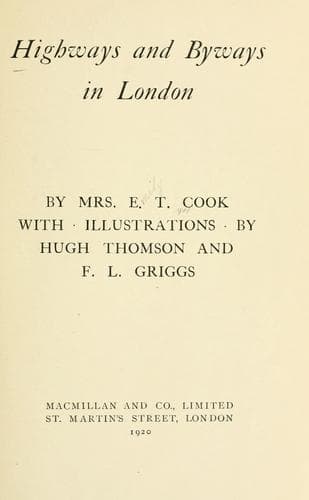
Highways and Byways in LondonCook, Emily Constance Baird
History
Highways and Byways in London
Cook, Emily Constance Baird
London (England) -- Description and travel
At the same time, it must be confessed, the poet regretted his pet's
inveterate tendencies toward "drain architecture." Rossetti's domestic
proclivities must, one thinks, have rendered him a terror to his
neighbours! Indeed, the only London inhabitant,--if we except the
celebrated "Lady of the Cats" in the desecrated Carlyle House,--who
can be said to have at all emulated him in that line, was Frank
Buckland the great naturalist, who, in his house, No. 34, Albany
Street, Regent's Park, kept "a museum and a menagerie in one." "His
house was full of crawling, creeping, barking, flying, swimming, and
squeaking things." When he was at church one Sunday, "Dick, the rat,"
he relates, "stole away two five-pound notes from my drawers." Among
other creatures Mr. Buckland kept, like Rossetti, a laughing jackass,
who "would never laugh," and "who was only provoked to a titter by the
consumption of a toothsome mouse"; this pet escaped from its cage one
day and was found asleep on the bed of a gentleman near the Hampstead
Road. But Mr. Buckland could at any rate excuse his vagaries on
scientific grounds, for he was trying to acclimatize foreign animals
suitable for food in this country.
The fleeting tide of fashion is now at its height in Chelsea; the
historic old houses of Cheyne Walk are let at enormous rents, and,
year by year, tall, prosaic red-brick edifices spring up like
mushrooms all round them. A few old "bits" of Chelsea still remain
unaltered,--but very few. The old church, and the rectory, the home of
the Kingsleys, with its charming old walled garden, are still
delightful; the embankment houses, standing back behind their gardens
and ironwork, are fine in their dignified, time-hallowed red-brick;
Paradise Row, that picturesque oasis of old dwellings that breaks the
ugliness of the modern Queen's Road West, yet bears witness to the
charm of old Chelsea. In humble Paradise Row, (now part of Queen's
Road West, and converted to laundries and other uses;)--in Paradise
Row, with its quaint tiled roofs, dormer windows, and high white
gate-posts, many well-known people have lived; it was even connected,
more or less, with royalty, for in 1692 it was the dwelling place of
the first Duke of St. Albans, Nell Gwynne's son. Chelsea has always
been associated with the Stuarts. When it was but a picturesque
riverside village,--fishermen's huts diversified by a few old
palaces,--divided yet by space of green fields from the storm and
stress of the greater London,--they brought it wealth and fashion, and
caused its gardens to spread in fragrant greenery down to the water's
edge. The Chelsea of the Restoration had the patronage of the
aristocracy, as well as that of the Royal favourites; here the King's
Mistresses flaunted their grandeur, their extravagance, their
impecuniosity before the world. It was in comparatively humble
Paradise Row that the notorious Duchesse de Mazarin lived in her later
Public-domain text, read in full here on John Shaqi.
Reviews
Reviews
No reviews yet
Be the first to share your thoughts on this work.
Elsewhere in the archive
Join the Discussion
Join the discussion
Sign in to leave a comment or review.
Sign InorCreate an account