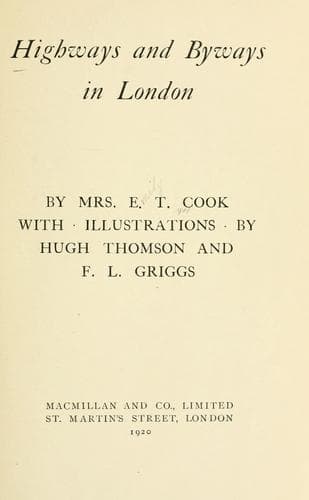
Highways and Byways in LondonCook, Emily Constance Baird
History
Highways and Byways in London
Cook, Emily Constance Baird
London (England) -- Description and travel
shall say how we love our "prison flower?"
The literary associations of Bloomsbury are yet another feature of its
charm. Though Russell Square and its surroundings generally are being
gradually rebuilt and improved, yet in some places you can still see
the actual old houses standing that, in the century's early years,
were the homes of celebrated men. Thus, No. 65 in Russell Square was
the abode of Sir Thomas Lawrence, the painter, and here he received
the distinguished sitters, the eminent men and fair ladies who have
made his name famous. Here, for instance, at this common-place house
door, while the Russian general Platoff was having his portrait
painted inside, were posted his attendant Cossacks, "mounted" says an
eye-witness, "on their small white horses, with their long spears
grounded," standing as sentinels at the door of the great painter.
Lawrence died here in 1830, and the house is not in essentials altered
since his day. At No. 5 in the square lived, from 1856 to 1862,
Frederick Denison Maurice, the "Christian Socialist," and here he held
his famous "prophetic breakfasts." At No. 56 Mary Russell Mitford
stayed in 1836. The house near by--No. 66--is a curious survival of
the days when Bloomsbury was a centre of fashion. Its enormous size,
its palatial reception rooms, its tall corridors, now deserted and
solitary except for a few colossal statues in niches, all suggest the
glare of light, the sound of music, the rustle of fine dresses that
filled it in old days. Hawthorne and Dickens suggested that old houses
felt and suffered; the same idea intrudes itself upon us here. The
rusted iron arches that used in the old days to support lamps,--now
darkened,--still hang here and there in Bloomsbury streets; and, in
some cases the actual iron torch-extinguishers that were used when
sedan chairs were in fashion, remain to tell their story of ancient
grandeur. Nothing is in its way more plaintive than an old and
desolate house of this kind; its glory departed, its decorations
falling to decay, its "garden" a wilderness of walls, roofs, and
broken bottles, its rooms, even, perchance, in course of being broken
up into solicitors' or other offices. Bloomsbury Square, indeed--the
square nearest to Holborn--has, in this way, entirely merged into
offices, the residents being practically ousted. But Russell Square,
despite the new Russell Hotel that rises palatially along its
north-eastern block, and despite the large Pitman's School of
Shorthand at its south-eastern corner, is still almost entirely
residential. None of its modern innovations can altogether abolish or
destroy the spirit and feeling of Thackeray that it breathes. Here
lived old Osborne, the purse-proud banker; there is going on old
Sedley's sale; I can see the packing-cases, the "loafers" and the vans
at this moment; and here, by these very prosaic green square railings,
is Amelia, sad and black garbed, looking with tear-filled eyes for her
boy George.
Public-domain text, read in full here on John Shaqi.
Reviews
Reviews
No reviews yet
Be the first to share your thoughts on this work.
Elsewhere in the archive
Join the Discussion
Join the discussion
Sign in to leave a comment or review.
Sign InorCreate an account